







Last updated:
Disclosure: some links in this article may be affiliate links. If you sign up through them we may earn a commission at no extra cost to you. It never affects our recommendations. Read our affiliate disclosure.
Most people hear the word “budget” and think of restriction: no more coffees, no more nights out, endless spreadsheets. In reality, a good budget does the opposite. It shows you exactly what you can afford, so you can spend on the things you care about without guilt, and stop wondering where your money went at the end of the month.
This guide shows you how to budget step by step, building your first budget from scratch in about an hour. You don’t need to be good with numbers, and you don’t need expensive software.
In this guide
- What is a budget, really?
- Why budgeting matters
- How to make a budget in 7 steps
- The 4 most popular budgeting methods
- A budget example
- What to do with the money you free up
- Budgeting with irregular income
- Budgeting tools: apps vs spreadsheets
- Common budgeting mistakes (and how to avoid them)
- Budgeting as a couple or family
- What budgeting taught me
- Frequently asked questions
- The bottom line
What is a budget, really?
A budget is simply a plan for your money. It answers three questions:
- How much money comes in each month?
- Where does it go?
- Where do you want it to go?
The gap between questions 2 and 3 is where the magic happens. Once you can see it, you can close it.
Why budgeting matters
- It stops money leaking away. Small, forgotten spending, such as unused subscriptions, takeaways and impulse buys, often adds up to more than people expect.
- It builds a safety net. A budget is how you find the money for an emergency fund, so a surprise bill doesn’t become debt.
- It helps you pay off debt faster. You can’t make a plan to clear debt without knowing what you can afford to put towards it.
- It funds your goals. Travel, a home, a business, early retirement: every goal needs money set aside on purpose.
- It reduces stress. Knowing where you stand is far less stressful than guessing.
How to make a budget in 7 steps
Step 1: Work out your monthly take-home income
Start with the money that actually lands in your bank account after tax and deductions, not your headline salary. Include every regular source: wages, side hustle income, benefits, child support and so on.
If your income varies (freelancers, gig workers, commission-based jobs), use your lowest typical month from the past six to twelve months as your baseline. Treat anything above that as a bonus to be allocated once it arrives. There’s more on irregular income below.
Step 2: Track where your money currently goes
Download your last two or three months of bank and credit card statements and sort every transaction into categories. Don’t judge yet; just get an honest picture. Common categories include:
- Housing (rent or mortgage, property tax, insurance)
- Utilities (energy, water, internet, phone)
- Groceries
- Transport (fuel, public transport, car payments, insurance)
- Debt repayments
- Insurance and healthcare
- Subscriptions
- Eating out and takeaways
- Shopping and personal care
- Entertainment and hobbies
- Gifts and special occasions
- Savings and investments
Tip: most banking apps now categorise spending automatically, which can save you a lot of time. You can also export your transactions and ask an AI assistant to help group them, but remove account numbers and other sensitive details first.
My experience
The biggest surprise when I first started tracking my spending wasn’t a big purchase. It was the number of small purchases I barely noticed at the time.
Subscriptions I’d forgotten about, convenience spending, takeaways after busy days and little impulse purchases didn’t seem significant individually. When I looked at a few months of spending together, however, the totals were much larger than I expected.
What I found interesting was that I wasn’t necessarily spending money on the wrong things. The real problem was that I wasn’t making conscious decisions about where my money was going. Tracking my spending gave me clarity rather than guilt.
For me, that was the most valuable part of budgeting. Before I could improve anything, I needed an honest picture of what was actually happening.
Step 3: Separate needs, wants and goals
Go through your categories and label each one:
- Needs: things you must pay to live and work: housing, utilities, basic groceries, transport to work, minimum debt payments, insurance.
- Wants: things that make life enjoyable but are optional: dining out, streaming services, holidays, new clothes beyond the basics.
- Goals: money for your future: emergency savings, extra debt repayments, investing, retirement.
Be honest. A phone is a need; the latest model on an expensive contract is partly a want.
Step 4: Choose a budgeting method
There’s no single right way to budget. Pick the method that fits your personality; the best budget is the one you’ll actually stick to. The four most popular are explained in the next section.
Step 5: Build your plan for next month
Using your chosen method, assign an amount to every category for the coming month. Start with needs, then goals, then wants. If the total is more than your income, trim wants first, then look for ways to reduce needs (for example by switching energy, phone or insurance providers).
Step 6: Automate as much as possible
Automation makes good habits effortless:
- Set up automatic transfers to savings on payday, so you save before you can spend.
- Put fixed bills on direct debit or autopay to avoid late fees.
- Consider separate accounts or “pots” for bills, spending and savings, so it’s obvious what’s available to spend.
Step 7: Review and adjust every month
Your first budget won’t be perfect, and that’s normal. At the end of each month, spend 15 minutes comparing what you planned with what actually happened. Adjust categories that were unrealistic, celebrate progress, and set next month’s plan. After three months, most people find their budget becomes accurate and almost automatic.
The 4 most popular budgeting methods
1. The 50/30/20 rule (best for beginners)
Split your take-home pay into three buckets:
- 50% for needs
- 30% for wants
- 20% for savings and extra debt repayments
It’s simple and flexible, which makes it a great starting point. In high-cost areas, needs may take more than 50%; that’s fine. Treat the percentages as a guide, not a rule, and adjust them to your situation.
2. Zero-based budgeting (best for control)
Give every unit of income a job until your income minus your planned spending, saving and debt payments equals zero. “Zero” doesn’t mean spending everything; savings and investments count as jobs too.
It takes more effort, but it’s very effective if you want to know exactly where every penny goes or you’re working hard to pay off debt.
3. Pay yourself first (best for hands-off people)
Decide how much you want to save or invest, set up an automatic transfer on payday, and then spend the rest however you like, as long as the bills are covered. You don’t track every category; you simply protect your savings first.
4. The envelope (or cash-stuffing) method (best for overspenders)
Allocate a fixed amount to each spending category, traditionally in physical cash envelopes. When an envelope is empty, spending in that category stops until next month. Many banking and budgeting apps now offer digital “envelopes” or pots that work the same way without carrying cash.
Not sure which to choose? Start with 50/30/20 for one month. If you find you need more control, switch to zero-based. If you hate tracking, try pay yourself first.
My experience
Over the years I’ve found myself using a combination of methods rather than following one approach rigidly.
The principle I come back to most often is “pay yourself first”. Whenever possible, I try to move money into savings, investments or business projects before I have a chance to spend it elsewhere. That simple habit has probably made more difference than any budgeting spreadsheet.
At the same time, I still like having visibility over where my money is going. For that reason, I often use aspects of zero-based budgeting when planning larger goals or managing business expenses, because it gives me more control and makes it easier to identify areas where money could be used more effectively.
My advice is not to worry about finding the perfect budgeting method. The best system is the one you’ll actually continue using six months from now.
A budget example
Here’s how the 50/30/20 rule might look for someone with a take-home income of 3,000 a month (in dollars, pounds or euros; the principle is the same). The figures are illustrative only.
| Category | Monthly amount | Bucket |
|---|---|---|
| Rent and utilities | 1,100 | Needs |
| Groceries | 300 | Needs |
| Transport | 150 | Needs |
| Insurance and phone | 100 | Needs |
| Total needs | 1,650 (55%) | |
| Eating out and entertainment | 350 | Wants |
| Shopping and personal | 200 | Wants |
| Subscriptions | 50 | Wants |
| Total wants | 600 (20%) | |
| Emergency fund | 300 | Goals |
| Extra debt repayment | 250 | Goals |
| Investing or retirement | 200 | Goals |
| Total goals | 750 (25%) | |
| Total | 3,000 |
Notice that needs are slightly above 50% here, balanced by spending less on wants. That’s exactly how the rule should work in practice: flexible, not rigid.
What to do with the money you free up
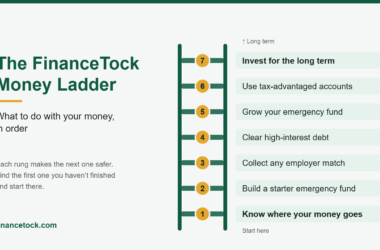
Once your budget shows a surplus, put it to work in roughly this order (adjust for your own situation). For the full sequence, with a guide for every step, see the FinanceTock Money Ladder.
- Build a starter emergency fund of about one month’s essential expenses, so small surprises don’t go on a credit card. See how to build an emergency fund on a tight budget.
- Get any employer retirement match if you have access to one; it’s effectively free money.
- Pay off high-interest debt, such as credit cards and payday loans.
- Grow your emergency fund towards three to six months of essential expenses.
- Invest for the long term and save for bigger goals. Our guide to how to start investing with 100 shows you where to begin.
Two ways to pay off debt
- Avalanche method: pay minimums on everything, then put extra money towards the debt with the highest interest rate. This saves the most money.
- Snowball method: pay minimums on everything, then attack the smallest balance first. Quick wins keep you motivated.
Both work. Choose the one you’ll stick with.
Budgeting with irregular income
If you’re a freelancer, creator or side hustler, your income may swing a lot from month to month. These habits help:
- Budget on your lowest typical month, not your average.
- Use a buffer account. Pay all income into one account, then pay yourself a steady “salary” from it each month.
- Set aside tax immediately. If tax isn’t deducted automatically, move a percentage of every payment into a separate tax account the day it arrives.
- Allocate windfalls deliberately. When a big month comes in, top up your buffer and emergency fund before increasing spending.
Budgeting tools: apps vs spreadsheets
- Your bank’s app: many now offer spending categories, savings pots and alerts for free. Start here.
- Budgeting apps: tools such as YNAB (You Need A Budget), Monarch Money and Goodbudget offer more detailed planning, goal tracking and shared budgets for couples. Compare them in our guide to the best budgeting apps for beginners. Check current pricing and which banks they support in your country.
- Spreadsheets: a simple Google Sheets or Excel template gives you full control and costs nothing. Great if you like to see every number.
- AI assistants: ChatGPT, Claude or Gemini can help you build a spreadsheet, suggest categories, or analyse an anonymised export of your spending. Never share passwords, full account numbers or other sensitive details. See our guide to the best AI tools.
My experience
I’ve experimented with budgeting apps, spreadsheets and various tracking tools over the years.
For day-to-day spending, I often start with the information already available through banking apps because it’s convenient and requires very little maintenance. For more detailed planning, particularly when setting financial goals or analysing larger projects, I still find spreadsheets incredibly valuable because of the flexibility they provide.
More recently, I’ve also started using AI tools to help analyse information, identify spending patterns and structure financial plans. While AI won’t replace good financial decisions, it can make the process of organising data and spotting trends much quicker.
If you’re new to budgeting, don’t overcomplicate things. A simple spreadsheet or budgeting app is more than enough to get started. You can always upgrade your system later once you’ve built the habit.
I’ve also created my own budgeting template to make the process easier, which I’ll be sharing here soon. If you’re looking for a simple way to get started, keep an eye out for that.
Common budgeting mistakes (and how to avoid them)
- Being too strict. A budget with zero fun money usually fails within weeks. Leave room for wants.
- Forgetting irregular expenses. Car repairs, annual subscriptions, birthdays and holidays happen every year. Divide their yearly cost by 12 and save for them monthly.
- Using gross instead of net income. Always budget with what actually reaches your account.
- Not tracking small purchases. Small daily spending adds up quickly over a month.
- Giving up after one bad month. Overspending happens. Adjust and keep going; consistency matters more than perfection.
- Never reviewing. Life changes. Revisit your budget monthly and whenever your income or costs change.
Budgeting as a couple or family
Money is one of the most common sources of relationship stress, so a shared plan helps. Agree on shared goals, decide which costs are joint and which are individual, and consider a joint account for shared bills plus personal accounts for individual spending. A short monthly “money date” to review the budget together keeps everyone on the same page.
What budgeting taught me
One lesson I’ve learned over the years is that budgeting isn’t really about money. It’s about priorities.
Every pound, dollar or euro you spend is helping build the life you want or pulling you away from it. Once I started viewing budgeting as a tool for achieving goals rather than restricting spending, my mindset changed completely.
A good budget shouldn’t make life feel smaller. It should help you spend confidently on the things that genuinely matter, while reducing the spending that doesn’t add much value.
That’s why I think budgeting is one of the most important personal finance skills anyone can learn. It gives you clarity, control and, ultimately, more freedom.
Sources and further reading
Last updated: November 2026.
Frequently asked questions
What is the easiest budgeting method for beginners?
The 50/30/20 rule is the easiest place to start: 50% of take-home pay for needs, 30% for wants and 20% for savings and debt repayment. Adjust the percentages to fit your situation.
How much of my income should I save?
A common guideline is at least 20% of take-home pay, but any amount is a good start. If 20% isn’t possible yet, begin with what you can, even a small amount, and increase it each time your income rises.
How big should my emergency fund be?
A common target is three to six months of essential expenses. Start with a smaller goal, such as one month, so it feels achievable, then build from there. Our emergency fund guide shows you how.
Should I save or pay off debt first?
Most people benefit from building a small emergency fund first, then focusing on high-interest debt, then growing savings further. High-interest debt usually costs more than savings earn.
How often should I review my budget?
Check in weekly for the first month or two, then monthly once it’s working. Review it whenever your income or major costs change.
The bottom line
Budgeting isn’t about saying no to everything; it’s about saying yes to what matters most. Work out your take-home pay, track your spending, pick a simple method and review it monthly. Within three months you’ll know exactly where your money goes, and you’ll be in control of where it goes next.
Want to increase the income side of your budget? See our guides to realistic ways to make money online and making money with AI.
This article is for general information only and isn’t personalised financial advice. Consider your own circumstances and seek professional advice where appropriate. Read our disclaimer.