







Last updated:
Disclosure: some links in this article may be affiliate links. If you sign up through them we may earn a commission at no extra cost to you. It never affects our recommendations. Read our affiliate disclosure.
Important: this guide is for education only and isn’t personalised investment advice. Investing involves risk, including the possible loss of the money you invest. Consider your own situation and seek advice from a licensed professional if you’re unsure. Read our disclaimer.
A generation ago, investing usually meant a stockbroker, high fees and a large minimum deposit. Today you can open an account on your phone in minutes, buy a slice of hundreds of companies with a few dollars, and pay little or nothing in commissions. The barrier to entry has never been lower.
The hard part isn’t the money anymore; it’s knowing where to start and avoiding the mistakes that cost beginners the most. This guide shows you how to start investing, step by step.
In this guide
- Why start investing with just $100?
- Before you invest: 3 things to check
- Step 1: Understand what you’re actually buying
- Step 2: Choose the right type of account
- Step 3: Pick a platform
- Step 4: Choose your first investment
- Step 5: Automate it
- Step 6: Leave it alone (mostly)
- Common beginner mistakes
- Where does AI fit in?
- What investing taught me about building wealth
- Frequently asked questions
- The bottom line
Why start investing with just $100?
Because time in the market matters more than the amount you start with. Thanks to compounding, where your returns start earning returns of their own, money invested early has longer to grow.
Here’s a hypothetical example. If you invested $100 a month and it grew at an average of 7% a year (an assumption for illustration; real returns vary and aren’t guaranteed):
| After | You’d have paid in | Hypothetical value |
|---|---|---|
| 10 years | $12,000 | about $17,300 |
| 20 years | $24,000 | about $52,100 |
| 30 years | $36,000 | about $122,000 |
The longer the time frame, the more of the final value comes from growth rather than from what you paid in. Starting small but early is often more powerful than starting big but late.
Starting with $100 also lets you learn how investing feels, including watching your balance fall during a bad month, while the stakes are low.
Before you invest: 3 things to check
- Do you have high-interest debt? Credit card interest is typically far higher than the long-term returns you can reasonably expect from investing. Paying it off is usually the best “investment” you can make first.
- Do you have an emergency fund? Aim for at least a small cash buffer, ideally building to three to six months of essential expenses, so you’re never forced to sell investments at a bad time to cover a surprise bill. See our guide to budgeting for how to find the money, and how to build an emergency fund on a tight budget.
- Can you leave the money alone for at least five years? Stock markets can fall sharply in the short term. Money you’ll need soon, for example for a house deposit next year, is usually better kept in savings.
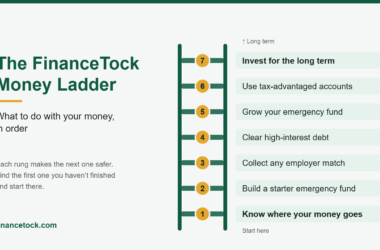
If you can answer “no high-interest debt, some savings, and five-plus years”, you’re ready to start. Not there yet? The FinanceTock Money Ladder shows the steps many people take first, in order.
Step 1: Understand what you’re actually buying
You’ll hear a lot of jargon. These are the basics:
- Stocks (shares): a small piece of ownership in a single company. If the company grows, your share can become more valuable; if it struggles, it can fall, sometimes to zero.
- Bonds: loans to governments or companies that pay interest. Generally lower risk and lower return than stocks.
- Funds: a basket of many investments bought together, so your money is spread across dozens or hundreds of companies at once.
- Index funds: funds that simply track a market index, such as the S&P 500 (500 large US companies) or a global index. They’re automatically diversified and usually very low-cost.
- ETFs (exchange-traded funds): funds that trade on a stock exchange like a single share. Many ETFs are index funds. See index funds vs ETFs for the differences.
Many beginners start with a low-cost, broadly diversified index fund or ETF, because it’s simple to understand. Instead of trying to pick winning companies, you own a small piece of the whole market.
Step 2: Choose the right type of account
Where you hold your investments can matter as much as what you buy, because some accounts offer valuable tax advantages.
Tax-advantaged retirement accounts
- United States: a workplace 401(k), especially if your employer matches contributions (that match is effectively free money), and Individual Retirement Accounts (Traditional or Roth IRA).
- United Kingdom: a Stocks and Shares ISA, where growth and withdrawals are free of UK tax, and pensions such as a workplace pension or SIPP.
- Elsewhere: most countries offer similar tax-advantaged accounts. Check your government’s official guidance.
Contribution limits and rules change regularly, so always check the current figures with the official source (for example the IRS in the US or HMRC in the UK).
Regular (taxable) brokerage accounts
A standard investment account has no special tax benefits but also no contribution limits or withdrawal restrictions. It’s useful once you’ve used your tax-advantaged allowances, or for goals before retirement.
A common order of priority is: get any employer match first, then use other tax-advantaged accounts, then a regular account. The right order for you depends on your circumstances.
Step 3: Pick a platform
You have three main options:
- Online brokers and investment apps: you choose your own investments. Look for no account minimums, low or no trading fees, and fractional shares, which let you buy part of a share or ETF with a small amount like $100.
- Robo-advisors: you answer questions about your goals and risk tolerance, and the service builds and manages a diversified portfolio automatically for a small annual fee. Great if you want a hands-off approach.
- Your workplace plan: if your employer offers a retirement plan, it may be the easiest place to start, with contributions taken straight from your pay.
What to compare
- Regulation and protection: make sure the provider is properly regulated in your country (for example by the SEC and FINRA in the US, or the FCA in the UK) and check what investor protection scheme applies.
- Fees: account fees, trading commissions and fund costs.
- Minimums: the minimum to open an account and to invest.
- Fractional shares and automatic investing: both make investing small amounts much easier.
- Range of funds: does it offer low-cost index funds and ETFs?
For a side-by-side comparison of popular platforms, see our guide to investing apps for beginners.
My experience
When I first started looking at investment platforms, I found the number of options surprisingly overwhelming. Every platform seemed to claim it was cheaper, easier or better than the competition.
What helped me most was focusing on a few practical questions rather than the marketing. Was the platform regulated? Were the fees reasonable? Could I understand the app without watching hours of tutorials? Most importantly, was it something I would actually feel comfortable using consistently?
I’ve learned that choosing a platform isn’t about finding the perfect app. It’s about finding one that makes it easy to invest regularly without overcomplicating the process.
If you’re just getting started, opening an account with a reputable provider is often more important than spending weeks comparing tiny differences between platforms. You can always refine your choices as your knowledge grows.
When you’re ready to compare, our side-by-side guide to investing apps for beginners focuses on the costs that keep coming every year, which matter far more than sign-up offers.
Step 4: Choose your first investment
Keep it simple. For many beginners, a single low-cost, broadly diversified fund is enough to start:
- A total market or S&P 500 index fund gives you exposure to hundreds of large companies.
- A global (all-world) index fund spreads your money across companies in many countries.
- A target-date fund (common in retirement accounts) automatically adjusts the mix of stocks and bonds as you approach a chosen retirement year.
Watch the fees
Every fund charges an annual fee called the expense ratio or ongoing charge. It looks tiny, but it’s taken every year and compounds over time. Many broad index funds charge a small fraction of what actively managed funds charge. All else being equal, lower fees leave more of the return for you.
Match your risk to your time frame
Stocks have historically grown more than bonds and cash over long periods, but with much bigger ups and downs. The longer you can invest, the more short-term swings you can usually ride out. If market drops would make you panic and sell, a mix that includes some bonds may suit you better.
Step 5: Automate it
The most powerful habit in investing is investing a fixed amount regularly, for example $100 every payday, regardless of what the market is doing. This is called dollar-cost averaging. You buy more shares when prices are low and fewer when they’re high, and you remove the temptation to time the market.
Most platforms let you set up automatic monthly investments in a couple of minutes. Set it, then increase the amount whenever your income rises.
Step 6: Leave it alone (mostly)
Once you’re set up, the hardest part is doing nothing. Markets will fall, sometimes sharply, and headlines will tell you the sky is falling. Historically, investors who stayed invested through downturns have generally done better than those who sold in a panic, though past performance doesn’t guarantee future results.
Check your portfolio occasionally, perhaps once or twice a year, to make sure it still matches your goals. You don’t need to look at it every day.
My experience
One of the biggest surprises while learning about investing was realising that successful investing often involves doing less, not more.
It’s natural to want to check your portfolio constantly, especially when markets are moving sharply or financial news is full of dramatic headlines. But some of the most successful long-term investors are surprisingly boring. They focus on their strategy, keep investing regularly and avoid making emotional decisions during market ups and downs.
The more I learned about investing, the more I noticed a common pattern: many investing mistakes come from reacting to short-term emotions rather than sticking to a long-term plan.
That’s one reason I’ve become far more interested in consistency than prediction. Nobody knows exactly what markets will do next month, but building good habits is something we can control.
Common beginner mistakes
- Trying to pick the next big stock. Even professional fund managers struggle to beat the market consistently. Diversified index funds avoid the problem.
- Trying to time the market. Waiting for the “perfect moment” usually means missing gains. Many people find regular investing easier to stick with.
- Selling in a panic. Selling after a fall turns a temporary drop into a permanent loss.
- Ignoring fees. High fees quietly eat your returns year after year.
- Following hype. Social media tips, meme stocks and “guaranteed” returns are red flags. If it sounds too good to be true, it probably is. Thinking about crypto? Read our crypto for beginners guide first and keep it to a small slice.
- Putting all your money in one place. Diversify across many companies, industries and countries.
- Investing money you’ll need soon. Keep short-term money in savings.
Where does AI fit in?
AI assistants can be genuinely useful for learning: explaining jargon, comparing account types, or helping you understand a fund’s documents. But AI tools can be wrong, and they don’t know your full financial situation. Don’t let any AI, app or influencer make investment decisions for you, and be very wary of services that claim AI can guarantee returns. Read more in can AI pick stocks?
What investing taught me about building wealth
One of the biggest misconceptions I used to have about investing was believing that successful investors started with large amounts of money.
The more I learned, the more I realised that consistency matters far more than the size of the first investment.
Most people don’t build wealth through a single brilliant stock pick or a lucky investment. They build it through regular contributions, patience and avoiding costly mistakes. That isn’t as exciting as the stories you often see on social media, but it’s a much more realistic path for most people.
It’s also one reason I believe beginners should spend less time looking for the “best” investment and more time developing the habit of investing regularly. In the long run, consistency often matters far more than perfection.
Sources and further reading
- GOV.UK: Individual Savings Accounts (ISAs)
- MoneyHelper: Investing
- Investor.gov (US SEC): Introduction to investing
- IRS: Retirement plans
Last updated: November 2026.
Frequently asked questions
Can I really start investing with $100?
Yes. Many brokers and apps have no minimum deposit and offer fractional shares, so you can buy a slice of an index fund or ETF with as little as a few dollars.
What do beginners often invest in?
There’s no single best investment for everyone, but many beginners start with a low-cost, broadly diversified index fund or ETF because it spreads risk across many companies and keeps costs low.
Is investing better than saving?
They do different jobs. Savings are for emergencies and short-term goals because the value doesn’t fall. Investing is for long-term goals, where you can accept ups and downs for the potential of higher growth. Most people need both.
Can I lose money investing?
Yes. The value of investments can go down as well as up, and you may get back less than you put in. Diversifying, keeping fees low and investing for the long term can reduce, but not remove, that risk.
How much should I invest each month?
Whatever you can consistently afford after covering essentials, building an emergency fund and paying off high-interest debt. Even small regular amounts add up over time. Increase it as your income grows.
The bottom line
You don’t need to be rich, or an expert, to start investing. Many beginners follow a simple sequence: clearing high-interest debt, building a small emergency fund, opening a tax-efficient account, using low-cost diversified funds and contributing regularly. Then give it time.
One thing I’ve noticed when talking to people about investing is that many spend years waiting for the perfect moment to start. They want more money, more knowledge or more confidence before taking the first step.
The reality is that most investors learn by investing. Whether you start with 100, 500 or 1,000 in your local currency, the important thing is getting started. The lessons you learn from investing a small amount today are often worth far more than waiting years for the “perfect” time to begin.
Your first investment is often the hardest because it requires action. After that, consistency usually matters far more than brilliance.
The goal isn’t to become an expert investor by next month. The goal is to start building habits that will benefit your future self for years, and hopefully decades, to come.
Looking for more money to invest? See our guides to budgeting, making money online and making money with AI.
This article is for general information and education only and does not constitute investment, tax or financial advice. Investing involves risk, including the loss of principal. Past performance does not guarantee future results. Figures in the example are hypothetical. Read our disclaimer.