







Disclosure: this article may contain affiliate links. If you sign up through them we may earn a commission at no extra cost to you. It never affects our recommendations. Read our affiliate disclosure.
Scroll social media for five minutes and someone will promise you thousands a month from “passive AI income.” Most of those promises are selling a course, not describing reality. Here’s the honest version: AI doesn’t make money on its own. People make money by using AI to do valuable work faster, cheaper or better than they could before.
That’s still a huge opportunity. Tasks that used to take a day, like a first draft, a video edit, a presentation or a basic chatbot, now take an hour. If you can combine that speed with good judgment and a bit of skill, you can sell results that businesses and customers happily pay for.
Below are 12 practical ways to make money with AI that genuinely work, grouped by how you earn: selling services, creating content, or building products. For each one we cover who it suits, the tools you’ll need, and how to get your first paying customer.
In this guide
- At a glance
- Part 1: Sell AI-powered services (fastest to first income)
- Part 2: Create AI-assisted content (slower start, bigger upside)
- Part 3: Build AI-assisted products (make once, sell many times)
- What doesn’t work (or no longer works)
- How to choose the right AI side hustle
- A simple 30-day starter plan
- Ground rules for earning with AI
- What AI has actually helped me achieve
- Frequently asked questions
- The bottom line
At a glance
| Side hustle | Startup cost | Time to first income | Best for |
|---|---|---|---|
| 1. AI-assisted writing and editing | Low | Weeks | Good writers |
| 2. Social media management | Low | Weeks | Organised, social-savvy people |
| 3. Chatbots and automation for small businesses | Low | Weeks to months | Problem-solvers, techie types |
| 4. Video editing and repurposing | Low | Weeks | Visual, detail-oriented people |
| 5. Presentations and pitch decks | Low | Weeks | Business-minded designers |
| 6. Voiceovers and audio | Low | Weeks | Creators, audio enthusiasts |
| 7. Translation and localisation | Low | Weeks | Bilingual people |
| 8. Faceless YouTube and short-form video | Low to medium | Months | Patient storytellers |
| 9. Niche blog or affiliate site | Low | 6 to 12 months | Consistent writers |
| 10. Digital products and templates | Low | Weeks to months | Makers, organisers |
| 11. Print-on-demand designs | Low | Months | Creative people with a niche |
| 12. Teaching AI skills | Low | Weeks to months | Experienced AI users |
Part 1: Sell AI-powered services (fastest to first income)
Services are the quickest route to real money because businesses pay for results now. You don’t need an audience, just a clear offer and a few examples of your work. Not sure which tools to use? See our guide to the best AI tools.
1. AI-assisted writing and editing
Businesses need a constant stream of blog posts, newsletters, product descriptions, website copy and social captions. AI makes first drafts fast; what clients pay for is a writer who can research properly, match their brand voice, check facts and make the result genuinely good.
Tools: ChatGPT or Claude for drafting and research, Grammarly for polish, Perplexity for sourced fact-checking.
How to start: pick a niche you know (for example SaaS, real estate or fitness), write three sample pieces, and pitch small businesses directly or list a specific offer on Upwork or Fiverr.
Reality check: clients increasingly spot generic AI text. Never deliver unedited AI output. Your editing and expertise are the product.
2. Social media management
Small businesses know they should post consistently but rarely have time. With AI you can plan a month of content, write captions, design graphics and repurpose one idea across several platforms in a fraction of the time it used to take.
Tools: ChatGPT or Claude for content calendars and captions, Canva for graphics, a scheduler such as Buffer or Later.
How to start: offer a simple monthly package (for example 12 posts across two platforms) to local businesses: cafés, salons, gyms and tradespeople often have weak social media and appreciate a local helper.
My experience
One thing I’ve learned through running businesses and building online projects is that consistency is usually more important than perfection when it comes to social media.
AI has made it much easier for me to plan content in batches rather than trying to think of something to post every day. Instead of staring at a blank screen, I can use AI to generate content ideas, draft captions, suggest variations for different platforms and create a month’s worth of content themes in a single session.
The biggest mistake I see is relying entirely on AI-generated posts. The posts that perform best are usually the ones that include real experiences, lessons learned or opinions. AI can help create the framework, but personality and authenticity still need to come from the person behind the account.
For anyone offering social media management as a service, the real value isn’t creating posts. It’s helping businesses stay visible and consistent without taking up hours of their time every week.
3. Chatbots and automation for small businesses
Many small businesses lose hours to repetitive admin: answering the same customer questions, copying data between apps, sending follow-up emails. You can set up AI chatbots for their website and automations that connect their tools, then charge a setup fee plus a monthly maintenance retainer.
Tools: Zapier or Make for automations, website chatbot builders, and a general AI assistant to help you design and troubleshoot. Our guide to AI tools for small business shows what your clients are likely to use.
How to start: automate something in your own life or for a friend’s business first, document the before-and-after time saved, and use that as your case study.
Why it pays well: you’re selling saved time, which is easy for a business owner to value.
4. Video editing and content repurposing
Podcasters, coaches and YouTubers produce long videos but need short clips for TikTok, Reels and Shorts. AI editing tools can find highlights, add captions and reformat footage quickly, so you can offer “one long video in, ten short clips out” as a package.
Tools: CapCut, Descript or Opus Clip-style highlight tools, plus Canva for thumbnails.
How to start: find a creator you like, make three free sample clips from their content, and send them over with a simple offer.
5. Presentations and pitch decks
Founders, consultants and sales teams constantly need polished slides. AI presentation tools generate a designed first version in minutes; you add the storytelling, structure and visual judgment that makes a deck persuasive. See our comparison of the best AI presentation makers to choose your toolkit.
Tools: Gamma, Canva, PowerPoint or Google Slides with AI features.
How to start: redesign a well-known public pitch deck as a portfolio piece, then pitch startups, coaches and small agencies.
6. Voiceovers and audio
AI voice tools can produce natural-sounding narration for explainer videos, training courses, audiobooks and YouTube channels. Clients still need someone who can write a good script, choose the right voice, fix pronunciation and deliver clean audio.
Tools: ElevenLabs or similar, plus a simple audio editor such as Audacity.
Important: only use voices you have the rights to, never clone someone’s voice without written permission, and tell clients when audio is AI-generated.
7. Translation and localisation
AI translation is now very good, but businesses still need a fluent human to check tone, cultural fit and accuracy, especially for marketing, legal and medical content. If you’re bilingual, you can offer fast AI-assisted translation with human review.
Tools: DeepL, ChatGPT or Claude, plus your own language skills.
How to start: target businesses selling into your second language’s market, or video creators who want subtitles and dubbing in another language.
Part 2: Create AI-assisted content (slower start, bigger upside)
Content businesses take longer to pay off, but once they work, a single article or video can earn for years through ads, affiliate links and sponsorships.
8. Faceless YouTube and short-form video
“Faceless” channels use voiceovers, stock footage, screen recordings or animation instead of a presenter. AI helps with scripting, voiceovers, editing and thumbnails, making it possible to run a channel without ever appearing on camera.
Tools: ChatGPT or Claude for research and scripts, ElevenLabs for voiceover, CapCut or similar for editing, Canva for thumbnails. See our comparison of the best AI video generators for faceless YouTube.
Reality check: platforms are cracking down on mass-produced, repetitive AI content, and channels like that can be refused monetisation. The faceless channels that succeed offer real value: original research, a distinctive point of view, genuine teaching. Check YouTube’s current monetisation policies and disclose realistic synthetic content where required.
My experience
I’ve explored AI-generated content extensively, and one thing has become very clear: creating content is easier than ever, but creating content that people actually want to watch is still difficult.
AI can help with research, scripting, voiceovers, editing and thumbnail creation, dramatically reducing the time it takes to produce videos. However, the channels that succeed are usually the ones that provide genuine value rather than simply pumping out large volumes of AI-generated content.
What I’ve found is that AI works best when it accelerates your creativity rather than replaces it. A strong idea, a useful lesson or a unique perspective will always outperform generic content, regardless of how advanced the tools are.
If you’re considering this route, focus on solving problems, teaching useful skills or sharing interesting insights rather than trying to automate the entire process.
9. Niche blog or affiliate site
A blog that answers real questions in a specific niche can earn from display ads, affiliate commissions and eventually your own products. New to affiliate income? Start with our guide to affiliate marketing for beginners. AI speeds up research, outlining and first drafts, but the blogs that rank and earn trust are the ones that add real experience, original insight and careful editing.
Tools: WordPress and reliable hosting (see our hosting guide), an AI assistant for research and drafting, and Google Search Console to track what’s working.
Reality check: Google’s spam policies target sites that mass-produce unhelpful content, however it’s made. Expect six to twelve months before meaningful search traffic.
My experience
I’m currently applying many of these principles while building FinanceTock.
Like most people starting a content website, I quickly realised that creating high-quality content consistently can be challenging. AI has been incredibly useful for research, topic planning, content outlines and identifying questions that readers are likely to ask.
However, the biggest lesson I’ve learned is that AI alone isn’t enough. The articles that stand out are the ones where I add my own experiences, observations and practical examples. That’s especially important now that search engines are placing greater emphasis on content that demonstrates real-world experience and expertise.
AI helps me work faster, but it doesn’t replace the need to understand the topic, fact-check information and provide unique insights that readers can’t find elsewhere.
Building a successful blog is still very much a long-term game, but AI can significantly reduce the time and effort required to get from an idea to a publishable article.
Part 3: Build AI-assisted products (make once, sell many times)
10. Digital products and templates
Spreadsheets, Notion templates, planners, checklists, prompt packs and ebooks can be created once and sold repeatedly with no inventory or shipping. AI helps you research what people want, draft content and design faster.
Tools: ChatGPT or Claude, Canva, Notion or Google Sheets, and a storefront such as Etsy, Gumroad or your own WooCommerce shop.
How to start: solve one specific problem for one specific person, for example “a monthly budget spreadsheet for freelancers with irregular income.” Specific products sell better than generic ones.
Watch out for: marketplaces are flooded with low-effort AI products. Quality, usefulness and good product photos set you apart.
11. Print-on-demand designs
Print-on-demand services print your designs on t-shirts, mugs, posters and more when a customer orders, and ship directly to them. AI image tools can help you brainstorm and create designs for a niche audience.
Tools: Midjourney, Adobe Firefly or Canva for design; a print-on-demand service connected to Etsy or your own store.
Important: avoid trademarks, celebrity likenesses and copying other artists’ styles. Check each marketplace’s rules on AI-generated art, and be aware that the copyright status of purely AI-generated images is limited in many countries.
12. Teaching AI skills
Many people and businesses want to use AI but don’t know where to start. If you’ve become genuinely good at it, you can run workshops, offer one-to-one coaching, consult for small businesses, or create a course teaching a specific skill, such as “AI for real estate agents” or “AI for bookkeepers.”
How to start: teach for free first, in a local business group, a webinar or a series of social posts, to test what people want and collect testimonials.
Tip: niche beats general. “AI for accountants” is easier to sell than “learn AI.”
What doesn’t work (or no longer works)
- Selling unedited AI output. Clients and readers can tell, and the value is close to zero because anyone can do it.
- Mass-publishing AI books, articles or videos. Platforms including Amazon, YouTube and Google actively demote or restrict low-quality, mass-produced content. Amazon’s Kindle Direct Publishing also asks authors to disclose AI-generated content.
- “Prompt engineering” as a stand-alone career. As AI tools get better at understanding plain language, simply writing prompts is rarely enough to sell. Pair it with a real skill.
- Expensive “AI income” courses promising guaranteed results. If the main way someone makes money is selling you a course about making money, be sceptical.
How to choose the right AI side hustle
- Start from a skill you already have. AI multiplies existing skills: a decent writer becomes a fast writer; an organised person becomes an efficient social media manager.
- Decide how soon you need income. Need money this month? Choose a service. Can wait six months or more? Build content or products alongside it.
- Pick one and commit for 90 days. Switching between ideas every few weeks is the most common reason side hustles fail.
A simple 30-day starter plan
- Week 1: choose one side hustle and one niche. Learn the two or three tools you’ll need (most have free plans).
- Week 2: create three portfolio samples that show the result you can deliver.
- Week 3: write a one-sentence offer (“I turn your long videos into 10 short clips a week”) and pitch 20 potential clients or list it on a freelance platform (our freelancing for beginners guide shows how).
- Week 4: deliver your first job brilliantly, ask for a testimonial, and refine your offer and price.
Ground rules for earning with AI
- Be transparent. Tell clients you use AI tools where it’s relevant, and follow each platform’s disclosure rules.
- Check facts. AI can state wrong information confidently. You’re responsible for what you deliver.
- Respect copyright and privacy. Don’t upload clients’ confidential data to AI tools without permission, and don’t copy other people’s work or styles.
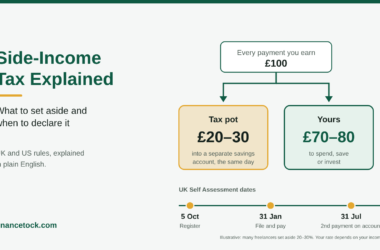
- Keep records and pay your taxes. Side-hustle income is usually taxable. Track income and expenses from day one, and see our guide to side-income tax for what to set aside.
What AI has actually helped me achieve
It’s easy to become sceptical when social media is full of exaggerated claims about AI making people rich overnight. My own experience has been much less dramatic, but far more useful.
AI has helped me write and publish books on Amazon, build websites, create content, develop business documents, improve processes and launch projects that would have taken considerably longer without it. In many cases, it hasn’t replaced the work; it’s reduced the time it takes to move from an idea to a finished product.
That’s why I believe the biggest opportunity isn’t selling AI itself. The opportunity is using AI to enhance skills you already have and applying those skills to create something people genuinely value.
Tax on side income
Last updated: November 2026.
Frequently asked questions
Can you really make money with AI?
Yes, but usually by using AI to deliver a service or product people already pay for, not by selling raw AI output. The most reliable income comes from combining AI speed with a real skill.
What is the easiest way to make money with AI as a beginner?
Services such as AI-assisted writing, social media management or video repurposing are the easiest starting points. They need little money upfront and you can land a first client within weeks.
Do I need to know how to code?
No. Almost every side hustle on this list uses no-code tools. Coding helps for advanced automation, and AI assistants can now help non-programmers write simple scripts too.
How much can I earn?
It varies enormously with your skill, niche, pricing and the hours you put in. Many people earn a modest extra income at first; a smaller number build full-time businesses over a year or more. Be wary of anyone promising specific figures.
Which AI tools should I start with?
One general AI assistant (ChatGPT, Claude or Gemini) plus Canva covers most beginners. See our guide to the best AI tools for recommendations by task.
The bottom line
The AI gold rush isn’t about pushing a button; it’s about doing useful work faster. Choose one side hustle that fits your skills, learn the tools, build a few samples and start pitching. Thirty days from now, you could have your first paying customer. For more ideas beyond AI, see our guide to realistic ways to make money online.
This article is for general information only and isn’t financial, legal or tax advice. Earnings vary widely and aren’t guaranteed.