







Last updated:
Car repairs, a broken boiler, a sudden vet bill, a job loss. Most of us know an unexpected expense is coming at some point; we just don’t know when. An emergency fund is the money you set aside for exactly those moments, so a surprise bill becomes an inconvenience instead of a crisis or a new debt.
If money is already tight, saving for “what if” can feel impossible. The good news is that you don’t need to save thousands at once. This guide shows you how much you really need, where to keep it, and 12 practical ways to build an emergency fund even on a tight budget.
In this guide
- What an emergency fund is (and isn’t) for
- How much you need
- How to work out your number
- Where to keep it
- 12 ways to build it when money is tight
- Emergency fund or paying off debt: which first?
- How to protect it from yourself
- Using it, and rebuilding afterwards
- Emergency funds with irregular income
- What finally changed my thinking about emergency funds
- Frequently asked questions
- The bottom line
What an emergency fund is (and isn’t) for
An emergency fund is cash you keep separate from your everyday spending and only touch when something unexpected, necessary and urgent happens. All three need to be true.
| Usually an emergency | Usually not an emergency |
|---|---|
| Losing your job or a big drop in income | A holiday or a weekend away |
| Urgent car repairs you need to get to work | A new phone because the old one is slow |
| Medical, dental or vet bills | Sales, discounts and “limited-time” deals |
| Essential home repairs (heating, a leaking roof) | Christmas, birthdays and annual bills you knew were coming |
| Emergency travel for a family crisis | Investing because the market looks cheap |
Predictable costs such as car insurance, annual subscriptions and holiday gifts aren’t emergencies; they’re expenses you can plan for. Save for those separately in what’s often called a sinking fund, so your emergency fund stays ready for real surprises.
How much you need
The most common guideline is three to six months of essential expenses. That’s the money you’d need to keep a roof over your head, the lights on and food on the table if your income stopped.
That can sound like a huge number, so break it into two stages:
- Starter emergency fund: about one month of essential expenses, or a smaller fixed amount you can reach in a few months. This covers most everyday surprises, such as a car repair or an urgent bill.
- Full emergency fund: three to six months of essential expenses, which protects you against bigger shocks such as losing your job.
When to aim for more than six months
- You’re self-employed, a freelancer or paid mostly by commission
- Your household relies on one income
- You have children or other dependants
- You work in an industry where jobs can take a long time to replace
- You have health issues or an older home or car that may need costly repairs
If you have a very secure job, two incomes and no dependants, three months may be enough.
How to work out your number
Your target is based on essential expenses, not your full spending. In an emergency you’d cut back on extras, so add up only what you must pay:
- Rent or mortgage
- Utilities: energy, water, internet and phone
- Groceries (a basic shop, not your usual one)
- Transport to work
- Insurance and essential healthcare
- Minimum debt payments
- Childcare and other essentials you can’t stop
Here’s an illustrative example for someone with essential costs of 2,000 a month (in dollars, pounds or euros; the principle is the same):
| Goal | Calculation | Target |
|---|---|---|
| Starter fund | 1 month of essentials | 2,000 |
| Full fund (minimum) | 3 months of essentials | 6,000 |
| Full fund (cautious) | 6 months of essentials | 12,000 |
If you don’t know your essential costs yet, our step-by-step budgeting guide shows you how to work them out in about an hour.
Where to keep it
Your emergency fund needs to be three things: safe, easy to reach within a day or two, and separate from your everyday spending money.
- A high-yield or easy-access savings account is a popular home for emergency savings. Your money earns some interest, you can withdraw it quickly, and it’s separate from your current account. See our guide to high-yield savings accounts.
- Check that your money is protected. In the US, look for a bank covered by FDIC insurance or a credit union covered by the NCUA. In the UK, check the provider is covered by the FSCS. These schemes protect deposits up to set limits if a bank fails; check the current limits on their official websites.
- Avoid fixed-term accounts for the main part of your fund. Accounts that lock your money away or charge penalties for early withdrawal defeat the purpose.
Where not to keep it
- Your everyday current or checking account: it’s too easy to spend by accident.
- Stocks, funds or crypto: their value can fall just when you need the money. Emergency savings should stay stable. Investing is for money you won’t need for at least five years; see how to start investing.
- Cash at home: a small amount for power cuts is fine, but larger sums can be lost or stolen and earn nothing.
- Your credit card: a credit limit isn’t an emergency fund. It turns an emergency into expensive debt.
12 ways to build it when money is tight
You don’t need to find a large sum all at once. Small, regular amounts add up faster than you’d expect. Combine a few of these ideas:
1. Start tiny, and automate it
Set up an automatic transfer to your emergency savings on payday, even if it’s a small amount. Automation removes willpower from the equation, and you can increase it as your budget allows.
2. Use round-ups
Many banks and apps can round up each card purchase to the nearest whole amount and save the difference. It’s painless and quietly builds a buffer.
3. Cancel one subscription and redirect the money
Review your bank statement for subscriptions you rarely use. Cancel one and set up a transfer for the same amount into savings, so you don’t simply spend the difference elsewhere.
4. Sell things you don’t use
Old phones, clothes, furniture, books and games can raise a surprising amount on local marketplaces and resale sites. It’s one of the fastest ways to fund your starter emergency fund.
5. Save windfalls
Tax refunds, bonuses, cash gifts and overtime pay are perfect for your emergency fund because you haven’t built them into your budget. Try saving at least half of every windfall until your fund is full.
6. Cut one big bill
Shopping around for car insurance, home insurance, energy, broadband or your phone contract can cut a large bill in one go. Put the monthly saving straight into your emergency fund.
7. Try a no-spend challenge
Pick a weekend, a week or a month where you only spend on essentials, then save the money you would have spent. It also shows you where your spending habits really are.
8. Plan your meals
Food is one of the easiest variable costs to reduce. Plan meals for the week, shop with a list, cook in batches and cut back on takeaways. Save what you don’t spend.
9. Earn extra for a set goal
A temporary side hustle with a clear target, such as “earn 1,000 for my starter fund”, can speed things up dramatically. See our guides to realistic ways to make money online and making money with AI.
10. Save half of every pay rise
When your income goes up, increase your automatic savings by half the difference before you get used to spending it. You still enjoy some of the raise, and your safety net grows without feeling a pinch.
11. Keep it out of sight
Many people find it easier to leave savings alone when they’re held at a different bank from their everyday account. If you can’t see the balance every time you check your spending, you’re less tempted to dip into it.
12. Make your progress visible
Set milestones, such as your first 500, your first month of expenses and then each extra month, and track them on a chart or in a notes app. Watching the number grow is surprisingly motivating.
My experience
The approach that worked best for me wasn’t finding a huge amount of money overnight. It was making saving automatic.
Like many people, I initially focused on trying to save whatever was left at the end of the month. The problem was that there was rarely much left. What made the difference was treating emergency savings as a bill that had to be paid, just like any other commitment.
I also found that directing unexpected income into savings accelerated progress significantly. Whether it was overtime, a tax refund, a bonus or money from selling items I no longer needed, I tried to avoid treating it as spending money until my emergency fund had reached a comfortable level.
Looking back, the most important lesson wasn’t how much I saved each month. It was building the habit. Once the habit was established, the balance grew naturally over time.
Emergency fund or paying off debt: which first?
It’s a common dilemma. For most people, this order works well:
- Build a starter emergency fund of about one month’s essential expenses, so a surprise doesn’t push you deeper into debt.
- Pay off high-interest debt, such as credit cards and payday loans, as quickly as you can. The interest on these debts is usually far higher than anything your savings will earn.
- Grow your emergency fund to three to six months of essential expenses.
- Then invest for the long term and save for bigger goals.
Keep making at least the minimum payments on all debts throughout. If you have an employer pension or retirement plan with matching contributions, it usually makes sense to contribute enough to get the full match even while you build your fund.
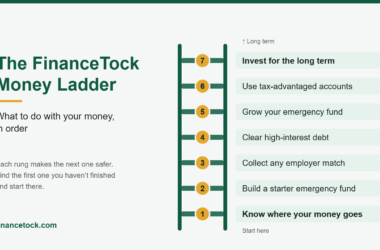
To see where your emergency fund fits in the bigger picture, from your first budget to long-term investing, see the FinanceTock Money Ladder.
How to protect it from yourself
The biggest threat to most emergency funds isn’t a bank failure; it’s us. A few simple rules help:
- Write down what counts as an emergency using the three tests: unexpected, necessary and urgent.
- Use a 24-hour rule for anything that isn’t truly urgent. If it can wait a day, it probably isn’t an emergency.
- Name the account “Emergency fund” or “Do not touch” in your banking app. It sounds small, but it works.
- Keep a separate fund for planned expenses such as gifts, holidays and annual bills, so you’re never tempted to borrow from your emergency savings.
Using it, and rebuilding afterwards
When a real emergency happens, use your fund without guilt. That’s exactly what it’s for, and it means you’ve avoided debt.
Afterwards:
- Pause extra goals temporarily, such as extra investing or overpaying a low-interest debt.
- Restart your automatic transfer straight away, ideally at a slightly higher amount for a few months.
- Direct windfalls to refilling the fund until it’s back to your target.
- Ask what you learned. If the emergency was a predictable cost in disguise, such as a car that needed regular repairs, start a separate fund for it.
My experience
One thing I’ve learned is that having an emergency fund changes more than just your bank balance. It changes how you react to problems.
When unexpected expenses arise, the stress isn’t only about the cost. It’s often the panic of trying to work out where the money is going to come from. Having even a modest emergency fund removes a lot of that pressure because you know there’s already a plan in place.
I’ve also learned not to feel guilty about using an emergency fund when a genuine emergency happens. That’s exactly what it’s there for. The goal isn’t to build a perfect savings account that never gets touched. The goal is to avoid turning an unexpected expense into expensive debt.
Every time I’ve used emergency savings for something genuinely necessary, I’ve reminded myself that the fund has done its job successfully.
Emergency funds with irregular income
If you’re a freelancer, creator, gig worker or side hustler, your income can rise and fall from month to month. That makes an emergency fund even more important.
- Aim higher: six months or more of essential expenses gives you room to ride out quiet periods.
- Separate your tax money: if tax isn’t taken automatically, move a percentage of every payment into a dedicated tax account. Tax money is not emergency money.
- Use a buffer account: pay all income into one account and pay yourself a steady monthly “salary” from it. Your emergency fund sits separately on top.
- Save a percentage, not a fixed amount: for example 10% of every payment, so you save more in good months automatically.
What finally changed my thinking about emergency funds
For years, I viewed emergency savings as money that wasn’t doing anything useful. It sat in an account earning relatively little interest while there were always other things I could have spent it on.
Over time, my perspective changed. I stopped viewing an emergency fund as an investment and started viewing it as insurance.
The purpose of the money isn’t to generate a high return. Its purpose is to provide options when life throws something unexpected your way.
The real return comes from reduced stress, avoiding unnecessary debt and having the ability to make better decisions under pressure. That’s difficult to measure on a spreadsheet, but it’s incredibly valuable when you need it most.
Sources and further reading
Last updated: November 2026.
Frequently asked questions
How much should I have in my emergency fund?
A common guideline is three to six months of essential expenses. Start with a smaller goal, such as one month, and build from there. If your income is irregular or you support others, aim for six months or more.
Where is the best place to keep an emergency fund?
For most people, a high-yield or easy-access savings account that’s separate from their everyday account and protected by a deposit insurance scheme. Your money stays safe, earns some interest and can be reached quickly.
Should I save for an emergency fund or pay off debt first?
Most people benefit from building a small starter fund first, then focusing on high-interest debt, then growing the fund to three to six months of expenses.
Should I invest my emergency fund?
Generally no. Investments can fall in value just when you need the money. Keep emergency savings in cash and invest separately for long-term goals.
How can I build an emergency fund on a low income?
Start with whatever you can, even a very small amount, and automate it. Add windfalls, sell unused items, cut one bill and redirect the savings. Progress matters more than the size of each deposit.
The bottom line
An emergency fund is the foundation of every other money goal. It protects you from debt, reduces stress and gives you choices when life doesn’t go to plan. One month of expenses is a great first milestone; three to six months gives you real peace of mind.
The biggest mistake people make is believing they need to save thousands before they can call it an emergency fund.
In reality, every emergency fund starts with the first deposit. Whether that’s 20, 50 or 500, the important thing is building the habit and creating separation between yourself and the next unexpected expense.
I’ve found that financial confidence rarely comes from earning a certain amount of money. More often, it comes from knowing you’re prepared when something goes wrong.
Work out your essential costs, set a realistic starter goal, automate whatever you can afford today and keep going. Your future self will thank you the first time life throws an unexpected bill your way and you realise you’re ready for it.
This article is for general information only and isn’t personalised financial advice. Savings protection limits and account features vary by country and provider; check the details before you open an account. Read our disclaimer.