








Some links in this article may be affiliate links, which means we may earn a small commission at no extra cost to you. It never affects which tools we recommend. See our affiliate disclosure.
Affiliate marketing is one of the most popular ways to earn money online, and one of the most misunderstood. You recommend a product, someone buys it through your link, and you earn a commission. Simple in theory. In practice, most beginners give up before they earn their first payment.
This guide explains how affiliate marketing really works, what you can realistically expect, where to find programmes, how to create content that people trust, and the disclosure rules you need to follow in the UK and US.
⚡ The short version
- Pick a niche you understand, where people buy products or software.
- Join programmes for products you’d genuinely recommend, directly or through networks.
- Create helpful content that answers buying questions: reviews, comparisons and tutorials.
- Disclose every affiliate link clearly.
- Be patient: affiliate marketing is usually measured in months rather than weeks, especially if you’re relying on search traffic.
In this guide
- What is affiliate marketing?
- Is affiliate marketing worth it? (realistic expectations)
- Affiliate marketing myths that keep beginners stuck
- Choosing a niche and products you can recommend honestly
- Where to find affiliate programmes
- Where to promote: blog, YouTube, email and social
- Content that converts
- Disclosure rules in the UK and US
- Beginner mistakes to avoid
- Frequently asked questions
- The bottom line
What is affiliate marketing?
Affiliate marketing is a partnership between a business and a publisher (the affiliate). The business gives you a unique tracking link. When someone clicks it and buys, signs up or takes another agreed action, you earn a commission.
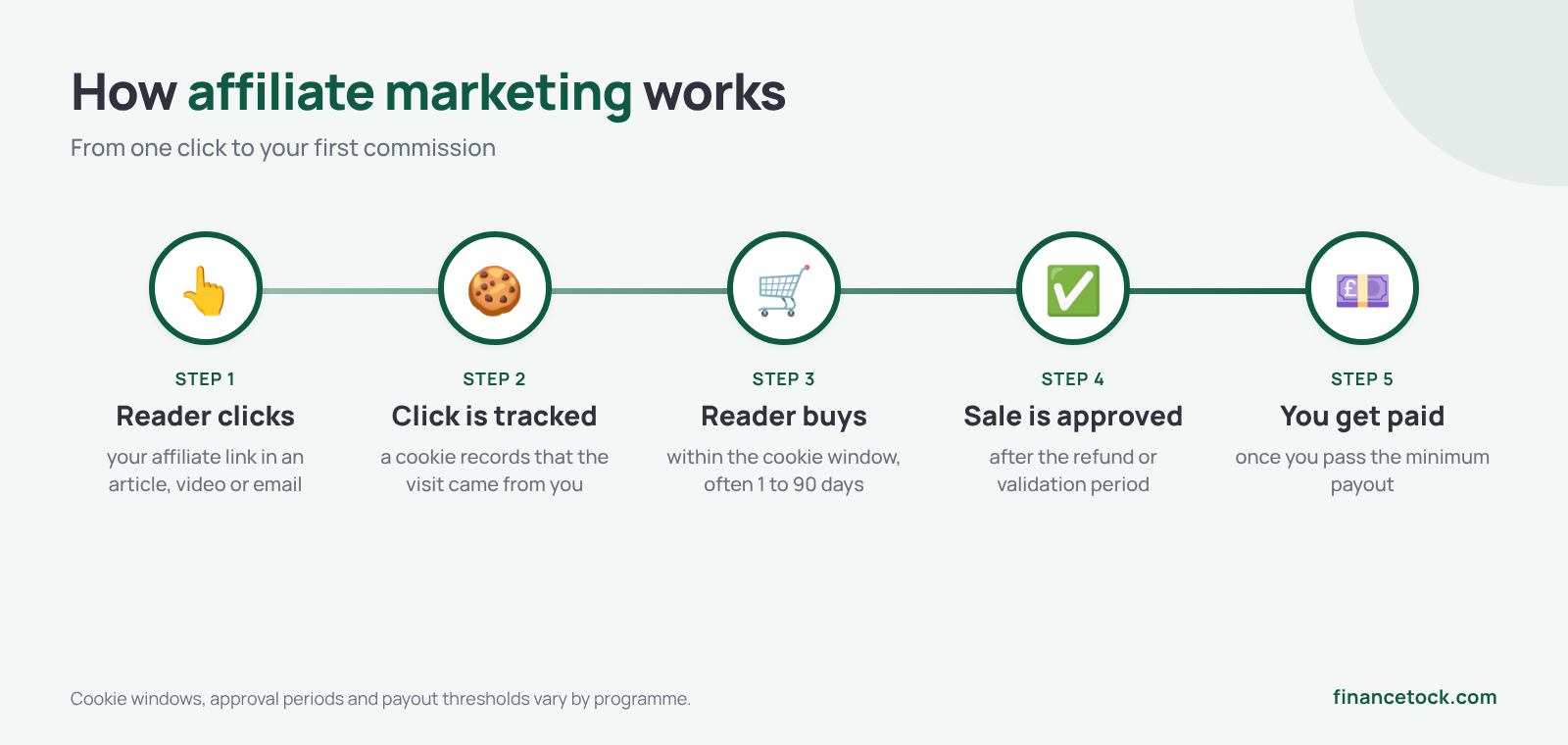
How tracking works
- A reader clicks your affiliate link.
- The merchant’s site places a tracking cookie (or uses a similar method) that records the click came from you.
- If the reader buys within the cookie window, the sale is credited to you. Windows range from 24 hours to 90 days or more, depending on the programme.
- After a validation period (to allow for refunds and cancellations), the commission is approved.
- You’re paid once your balance reaches the programme’s minimum payout, often somewhere between £25 and £100 ($25 to $100).
Types of commission
| Type | How it pays | Typical examples |
|---|---|---|
| Percentage of sale | A share of the order value, often in the single digits for physical products | Retailers and marketplaces such as Amazon |
| Flat fee per sale | A fixed amount for each new customer | Web hosting, financial products, some apps |
| Recurring commission | A share of every monthly or yearly payment while the customer stays | Software and subscription tools (SaaS) |
| Per lead or sign-up | A fee for a free trial, quote request or account sign-up | Insurance quotes, free trials, comparison services |
Recurring commissions are especially valuable: one well-placed recommendation for a software tool can keep paying for months or years.
Is affiliate marketing worth it? (realistic expectations)
Affiliate marketing can be worth it, but only if you treat it as a long-term business rather than a quick win.
What tends to be true for beginners:
- It’s slow at first. If you rely on search traffic, it often takes 6 to 12 months before content ranks well enough to earn consistently.
- Income is uneven. A handful of articles or videos usually earn most of the commissions.
- Trust drives sales. Readers buy when they believe your recommendation, which is why honest, experience-based content performs best over time.
- It compounds. Content you publish today can keep earning for years if you keep it updated.
🧮 A quick reality check
Commissions are a small share of a small share. If 1,000 people read a review, perhaps 50 click your link and 1 to 3 buy, depending on the product and how well the content matches what readers want. That’s why affiliate income depends on targeted traffic and trust, not just traffic.
Affiliate marketing myths that keep beginners stuck
Myth 1: Affiliate marketing is passive income
Reality: affiliate marketing can become partly passive, but the beginning looks nothing like passive income.
Before a single commission arrives, most people spend their time:
- Learning
- Writing
- Recording videos
- Building websites
- Testing products
- Updating old content
The “passive” phase comes after a lot of active work, if it comes at all. Many beginners quit because they expected passive income in month one and got effort instead.
Myth 2: You need millions of visitors
Reality: you need relevant visitors.
A review read by 100 people actively looking to buy a product can outperform an article read by 10,000 people who have no intention of spending money.
Traffic matters. Intent matters more.
Ten visitors looking for a solution are often worth more than a thousand people who are merely curious.
Myth 3: More affiliate links means more money
Reality: links don’t create trust. Trust creates clicks.
A useful article with two relevant recommendations often outperforms a page packed with affiliate links. Readers are surprisingly good at spotting the difference between “here’s a product I genuinely think helps” and “here’s every product I could find”.
Myth 4: You need to be an expert
Reality: you don’t need to know everything. You need to know more than the person reading today.
Many successful affiliate sites are built by people documenting their learning, their testing and their comparisons, rather than positioning themselves as gurus.
Honesty is often more valuable than expertise.
Myth 5: The hard part is choosing the perfect niche
Reality: most people don’t fail because they chose the wrong niche. They fail because they stop producing content before Google and readers have a chance to find them.
A good niche matters. Persistence matters far more.
🔄 FinanceTock Contrarian
Many beginners spend weeks researching affiliate programmes before they’ve written a single useful article.
The programme is rarely the bottleneck. The content usually is.
A great article with an average affiliate programme often earns more than an average article with the highest-paying programme available.
🤔 Worth thinking about
Picture yourself six months from now. Would you rather have a folder full of notes on niches, commission rates, SEO tools and monetisation strategies, or 26 published articles that Google can discover and readers can trust?
Neither guarantees success. But only one of them can earn.
Most affiliate marketers don’t fail because of a lack of information. They fail because they never move from planning to publishing.
Choosing a niche and products you can recommend honestly
The best niches combine three things: you understand the topic, people actively buy products in it, and there are programmes worth joining. Personal finance, software and AI tools, web hosting, home and garden, health and fitness, travel and hobbies all have strong affiliate options.
Before you promote anything, ask:
- Would I recommend this without a commission? If not, don’t promote it.
- Have I used it, or can I test it properly? First-hand experience makes your content more useful and more convincing.
- Does the merchant treat customers well? Poor support or hidden renewal prices will cost you trust, and refunds cost you commissions.
- Is the commission worth the effort? Compare the payout, cookie length and conversion rate, not just the headline percentage.
A focused niche makes everything easier: it’s clearer who you’re writing for, which products fit, and which searches you can realistically rank for. Our guide to how to start a blog covers choosing a niche in more detail.
Where to find affiliate programmes
Direct programmes
Many companies run their own affiliate programmes. Look for an “Affiliates” or “Partners” link in the footer of their website. Software companies, hosting providers such as Hostinger, online course platforms and many retailers run programmes this way.
Affiliate networks
Networks host thousands of programmes in one place, with a single dashboard and payout:
- Awin: a large network with strong UK coverage. ShareASale programmes have moved to Awin.
- Impact: popular with big brands and software companies.
- CJ (Commission Junction): one of the longest-running networks, with many well-known brands.
- PartnerStack: focused on software and SaaS, often with recurring commissions.
- Rakuten Advertising: many retail and fashion brands.
Amazon Associates
Amazon Associates is often the first programme beginners join because it’s easy to get into and covers almost every product, but it’s rarely the last. The trade-offs: commission rates are relatively low and vary by category, the cookie lasts just 24 hours, and new accounts must make qualifying sales within their first 180 days to stay approved. It works best for product round-ups and gear guides.
Many experienced affiliates eventually focus on software tools, services and recurring commissions because one referral can be worth far more than several product sales.
💡 Tip
Many programmes review your site or channel before approving you. Having your About, Contact, Privacy and Disclaimer pages in place, plus a handful of genuinely useful posts, improves your chances.
Where to promote: blog, YouTube, email and social
| Channel | Strengths | Watch out for |
|---|---|---|
| Blog | Search traffic from people actively researching purchases; content earns for years | Slow to start; needs SEO and regular updates |
| YouTube | Demonstrations build trust fast; videos rank in Google and YouTube search | Time-consuming to produce; links sit in the description |
| Email list | An audience you own; high trust and repeat visits | Needs a reason to subscribe; don’t overload subscribers with offers |
| Social media | Fast reach and engagement | Short-lived posts, changing algorithms, platform rules on links |
Many successful affiliates combine a blog or YouTube channel (for search traffic) with an email list (for repeat readers). Our guides to AI video tools for faceless YouTube channels and ways to make money online cover other routes.
Content that converts
People click affiliate links when they’re close to a decision. The content types that tend to convert best:
- Honest reviews: what the product does, who it suits, who it doesn’t, pros and cons, pricing and your own experience.
- Comparisons: “X vs Y” articles help readers choose between two options they’re already considering.
- Best-of lists: “best tools for [job]”, organised by use case rather than a random ranking.
- Tutorials: how to do something with a product, such as setting up WordPress on a host or automating a task with a tool.
- Resource pages: a page listing the tools you actually use, with a sentence on why.
What makes this content work:
- Screenshots, photos, results and examples from your own use.
- Clear “who it’s for” and “who should skip it” sections.
- Up-to-date prices and features, with a “last checked” date.
- Honest downsides. Readers trust a review more when it admits weaknesses.
AI tools can help you research and organise these articles faster; see our guide to the best AI writing tools. But the experience, testing and judgement need to come from you.
Disclosure rules in the UK and US
You must clearly tell readers when you earn money from a link. It’s a legal requirement, and it builds trust.
United Kingdom
- Under the UK advertising rules (the CAP Code, enforced by the ASA), affiliate content is advertising and must be obviously identifiable as such.
- On social media, the ASA recommends a clear label such as “#ad” or “Ad” at the start of the post. Vague wording like “affiliate” on its own, or a disclosure hidden among hashtags, may not be enough.
- The Competition and Markets Authority (CMA) also expects paid relationships and incentives to be disclosed clearly.
United States
- The FTC’s Endorsement Guides require a clear and conspicuous disclosure of any material connection, including affiliate commissions.
- The disclosure should be close to the recommendation and easy to see, not buried in a footer or a separate page alone.
- Plain language works best, such as “I earn a commission if you buy through this link.”
Search engines
Google asks sites to mark affiliate links with rel="sponsored" (or rel="nofollow"). Most affiliate link plugins and website builders can add this automatically.
Beginner mistakes to avoid
- Promoting products you haven’t used or wouldn’t recommend to a friend.
- Chasing the highest commission instead of the best fit for your readers.
- Thin content: short “reviews” that repeat the sales page add nothing, and rarely rank or convert.
- Too many links: a page stuffed with links looks like an advert, not advice.
- Forgetting to update: outdated prices, discontinued products and broken links quietly cost you sales.
- Relying on one platform or programme: programmes change commission rates or close. Diversify over time.
- Not disclosing, or hiding disclosures where readers won’t see them.
- Ignoring tax: affiliate income is taxable. In the UK, if your trading income is more than £1,000 in a tax year (the trading allowance), you’ll generally need to register for Self Assessment. In the US, affiliate income must be reported whether or not you receive a tax form. Our guide to side-income tax explains what to set aside and when to declare it.
Sources and further reading
- ASA: Affiliate marketing
- FTC: Disclosures 101
- FTC: Endorsement Guides, what people are asking
- Google Search Central: Qualify your outbound links
- GOV.UK: Tax-free allowances on trading income
Last checked: November 2026.
Frequently asked questions
How much do affiliate marketers make?
It varies enormously. Many beginners earn little or nothing in their first months, while established sites can earn a full-time income. Results depend on your niche, traffic, the trust you build and the programmes you choose.
Do I need a website to do affiliate marketing?
Not strictly. You can share links through YouTube, email or social media, depending on each programme’s rules. A website gives you more control and long-term search traffic, though. Budget hosts make starting one inexpensive; see our guide to choosing web hosting.
How long does it take to earn your first commission?
With search traffic, many people wait several months for their first steady commissions. Promoting to an existing audience or email list can be faster.
Is affiliate marketing passive income?
Partly. Content can earn long after you publish it, but it needs regular updates, new content and promotion to keep earning.
Can I do affiliate marketing with no money?
You can start on free platforms such as YouTube or social media, but most serious affiliates eventually invest in a website, a domain and an email tool. The costs are usually modest compared with other businesses.
Do I have to pay tax on affiliate income?
Yes. Affiliate commissions are taxable income. In the UK, the £1,000 trading allowance may cover very small amounts; above that you’ll generally need to register for Self Assessment. In the US, report all income on your tax return. Check official guidance or speak to an accountant for your situation.
The bottom line
Affiliate marketing isn’t a traffic business first. It’s a trust business first.
It works when you choose a focused niche, recommend products you genuinely believe in, create content that helps people make decisions, and disclose every link clearly.
It’s rarely quick, and it’s never truly hands-off, but helpful content can keep earning for years. If you’re ready to build your own platform, start with our step-by-step guide to starting a blog that makes money.
This article is for general information only and isn’t legal, tax or financial advice. Programme terms, commission rates and rules change; check each programme’s current terms and official guidance. Read our disclaimer.