








Some links in this article may be affiliate links, which means we may earn a small commission at no extra cost to you. It never affects which tools we recommend. See our affiliate disclosure.
Freelancing is one of the most realistic ways to earn money online. There’s no stock to buy, no audience to build first and no waiting months for a blog to rank. (If you’d like to do both, our guide to how to start a blog explains the longer-term route.) If you have a useful skill and can find people who need it, you can start earning within weeks.
But most beginners get stuck in the same places: choosing what to offer, proving they’re good with no past clients, finding that first paying customer and knowing what to charge. This guide walks through how to start freelancing step by step, from picking a niche to getting paid and staying on the right side of the taxman, with templates you can adapt.
In this guide
- What freelancing really is (pros and cons)
- Choose a skill and a niche
- Build a portfolio with no clients
- Where to find clients: platforms vs direct outreach
- How to price your services as a beginner
- Writing proposals that win
- Getting paid, contracts and taxes
- Using AI to work faster (without hurting quality)
- The freelancing mistakes that cost beginners the most
- Frequently asked questions
- The bottom line
What freelancing really is (pros and cons)
A freelancer is self-employed and sells their services to clients, usually per project, per hour or on a monthly retainer, instead of working for one employer.
| Pros | Cons |
|---|---|
| Choose your clients, projects and hours | Income can be irregular, especially at first |
| Start part-time alongside a job | No sick pay, holiday pay or employer pension |
| Earning potential grows with your skills and reputation | You handle your own tax, admin and chasing invoices |
| Work from anywhere with a laptop | Finding clients is part of the job, every month |
Many successful freelancers start on the side, keep their job until freelance income is steady, and build a cash buffer before going full-time. Our guide to building an emergency fund includes tips for irregular income.
Choose a skill and a niche
Start with a skill you already have, or can learn quickly, that businesses regularly pay for:
- Writing and editing: blog posts, website copy, newsletters, product descriptions.
- Design: social media graphics, logos, presentations, Canva templates.
- Video: editing YouTube videos, short-form clips, captions.
- Social media management: planning, posting and reporting for small businesses.
- Virtual assistance and admin: inbox management, scheduling, data entry, research.
- Websites: WordPress setup, updates, speed and maintenance.
- Bookkeeping: for small businesses, if you have the right experience.
- AI services: setting up chatbots and automations for small businesses.
Then narrow it down. “I’m a writer” competes with millions of people. “I write email newsletters for independent fitness studios” competes with very few and is easier to sell, because the client instantly sees you understand their world. You can always broaden later.
Build a portfolio with no clients
You don’t need past clients to have a portfolio. You need proof you can do the work:
- Create sample projects for imaginary or real businesses in your niche: three blog posts, a set of social graphics, a redesigned landing page or an edited video.
- Improve something that exists: rewrite a local business’s homepage or redesign a menu, clearly labelled as a concept.
- Do one or two discounted projects for real clients in exchange for a testimonial, with a clear end date.
- Put it in one place: a simple website, a Notion page, a Google Drive folder or a profile on Behance or Contra.
Three strong, relevant samples beat twenty random ones.
Where to find clients: platforms vs direct outreach
Freelance platforms
- Upwork: clients post jobs and freelancers send proposals. Competitive, but good for building a track record. Freelancers pay a service fee on their earnings, and sending proposals uses paid credits (“Connects”).
- Fiverr: you list fixed-price packages (“gigs”) and clients come to you. Fiverr keeps 20% of each order.
- Niche platforms: Contra, Toptal (for experienced developers and designers), PeoplePerHour (popular in the UK) and industry-specific job boards.
Direct outreach
Platforms are useful at the start, but many freelancers find their best-paid work comes from direct relationships:
- LinkedIn: optimise your profile for your niche, share examples of your work and connect with potential clients.
- Your network: tell friends, former colleagues and local business owners what you now offer.
- Cold email: a short, personalised message to businesses you can genuinely help.
Keep it short, specific and about them, not you. Follow up once after a week, then move on.
How to price your services as a beginner
Underpricing is the most common beginner mistake. Low prices attract difficult clients and leave no room for tax, admin time or quiet months.
A simple way to set a starting rate:
- Decide your target annual income before tax.
- Add your business costs: software, equipment, insurance, accountant, pension contributions.
- Estimate your billable hours. After admin, marketing, holidays and sick days, many freelancers bill around 20 to 25 hours a week, for about 46 weeks a year.
- Divide income plus costs by billable hours.
Illustrative example: a target of £30,000 plus £3,000 of costs, divided by about 1,000 billable hours a year, gives roughly £33 an hour. Check what others in your niche charge and adjust from there.
As you gain experience, consider moving from hourly to project or package pricing (“4 blog posts a month for £X”). Clients find it easier to budget, and you benefit from working faster.
Writing proposals that win
Whether on Upwork or by email, winning proposals tend to follow the same pattern:
- Open with their problem, not your life story: “You need a weekly newsletter that brings past customers back.”
- Show you read the brief by mentioning a specific detail.
- Explain your approach in two or three sentences.
- Share one or two relevant samples.
- Give a clear price and timeline, or a range if you need more information.
- End with an easy next step: “Happy to jump on a 15-minute call this week.”
Short and specific beats long and generic every time.
Getting paid, contracts and taxes
Contracts
Even for small jobs, put the basics in writing: what’s included, number of revisions, deadlines, price, payment terms and what happens if the project changes. A simple written agreement or a confirmed email is far better than nothing. Many freelancers take a deposit of 25% to 50% upfront for new clients.
Invoicing and getting paid
Accounting and invoicing tools such as FreeAgent and QuickBooks (UK), or QuickBooks and Bonsai (US), let you send professional invoices, track payments and send automatic reminders. Platforms like Upwork and Fiverr handle payment for you, in exchange for their fees.
Taxes in the UK
- If your self-employed income is more than £1,000 in a tax year (the trading allowance), you’ll generally need to register with HMRC and complete a Self Assessment tax return.
- You pay Income Tax and Class 4 National Insurance on your profits, usually in payments on account.
- Making Tax Digital for Income Tax is being phased in, starting with self-employed people and landlords with higher incomes, requiring digital records and quarterly updates.
- Online platforms now report sellers’ income to HMRC, so assume your earnings are visible.
Taxes in the US
- Self-employed income is subject to income tax and self-employment tax (Social Security and Medicare), currently 15.3% on most net earnings.
- You usually need to make quarterly estimated tax payments.
- Clients and platforms may send you Form 1099-NEC or 1099-K. Reporting thresholds have changed recently, but all income is taxable whether or not you receive a form.
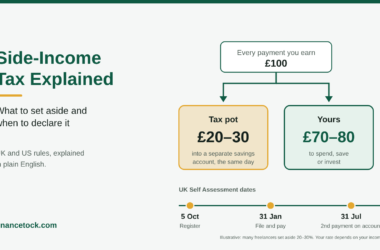
Many freelancers move a fixed share of every payment, often 20% to 30%, into a separate savings account for tax (our guide to side-income tax explains how to work out your own figure). A high-yield savings account lets that money earn interest until the bill is due. For anything beyond the basics, an accountant usually pays for themselves.
Using AI to work faster (without hurting quality)
AI tools can make freelancers faster, but clients pay for quality and judgement, not just speed.
- Good uses: research, outlines, first drafts, editing, summarising briefs, drafting proposals and admin emails.
- Keep the value human: your expertise, voice, strategy and final quality check.
- Be transparent: check whether your contract allows AI use, and be honest if a client asks.
- Protect confidentiality: don’t paste client data or confidential material into AI tools without permission.
Our guides to the best AI writing tools and AI tools for small business cover the tools many freelancers use, and how to make money with AI lists AI-powered services you could offer.
The freelancing mistakes that cost beginners the most
Most beginners think their biggest challenge is finding clients.
In reality, the bigger challenge is avoiding the mistakes that quietly limit growth long after the first client arrives.
1. Charging too little
Underpricing feels like the safest way to win work.
The problem is that the lowest prices often attract the most demanding clients.
When someone buys because you’re cheap, they’ll often leave as soon as someone cheaper appears.
When someone buys because they trust your expertise, they’re usually far more interested in results than saving a few pounds.
I’ve seen business owners happily pay more for a freelancer who understands their problem and communicates well. Price matters, but confidence and competence matter more.
2. Working without a clear agreement
A surprising number of disputes start because nobody wrote down what was included.
A client asks for “a few changes”.
The freelancer believes the project is finished.
The client thinks those changes were included all along.
Neither person is necessarily being unreasonable.
They simply had different expectations.
Even a simple written agreement covering deliverables, revisions, deadlines and payment terms eliminates most of these problems before they start.
3. Letting scope creep become normal
Scope creep is when a project quietly grows beyond what was originally agreed.
One extra revision becomes three.
One page becomes five.
One monthly task becomes ongoing support.
Most freelancers experience this at some stage because they want to be helpful and keep clients happy.
The problem isn’t saying yes occasionally. The problem is saying yes so often that profitable work becomes unprofitable.
Good clients respect clear boundaries when they’re explained professionally.
4. Waiting for the perfect portfolio
This is one of the biggest reasons people never start.
They tell themselves:
- I’ll start once my website is finished.
- I’ll start once I’ve redesigned my portfolio.
- I’ll start once I’ve completed one more course.
- I’ll start once I feel more confident.
Meanwhile, other freelancers with less experience are already speaking to clients.
Most portfolios improve because of work, not before it.
Three strong examples and ten conversations with potential clients will usually teach you more than another month of preparation.
Sources and further reading
- GOV.UK: Working for yourself
- GOV.UK: Register for Self Assessment
- IRS: Self-employed individuals tax center
Last checked: November 2026.
Frequently asked questions
How do I start freelancing with no experience?
Pick one skill, narrow it to a niche, create three sample projects, and start pitching on a platform and through direct outreach. A couple of discounted projects for testimonials can help you build credibility quickly.
How much should I charge as a beginner freelancer?
Work out a rate from your target income, costs and realistic billable hours, then compare it with others in your niche. Many beginners underprice; it’s usually easier to win clients with a clear niche and strong samples than with the lowest price.
Do I need to register as self-employed?
In the UK, you generally need to register with HMRC once your self-employed income exceeds £1,000 in a tax year. In the US, self-employment income must be reported, and quarterly estimated taxes are usually required. Check the official guidance for your situation.
Is Upwork or Fiverr better for beginners?
Fiverr suits clear, fixed-price packages where clients come to you; Upwork suits responding to specific client briefs. Many freelancers try both, then focus on whichever brings better clients.
How long does it take to get your first client?
It varies, but with a clear offer, samples and consistent outreach, many freelancers land their first paid project within a few weeks to a couple of months.
The bottom line
Freelancing is one of the fastest ways to turn a skill into income, but it’s a business, not a lottery ticket. Choose a specific offer, build proof with sample work, reach out consistently, charge enough to cover tax and quiet months, and put agreements in writing.
Start part-time if you can, set money aside for tax from day one, and treat every project as a chance to earn a testimonial and a referral. For more ways to earn online, see our guide to making money online.
This article is for general information only and isn’t tax, legal or financial advice. Tax rules and thresholds change and depend on your circumstances; check official guidance or speak to an accountant. Read our disclaimer.