







Capital at risk: investing involves risk, and the value of investments can fall as well as rise. This article is for general education only. It doesn’t recommend any stocks, funds or services and isn’t personal financial advice. Read our disclaimer.
Scroll social media for long enough and you’ll see the claim: “This AI picks winning stocks.” Apps promise AI-powered trading signals, influencers share chatbot stock tips, and adverts show dashboards full of profits generated by “advanced algorithms”.
It’s an appealing idea. If AI can write essays, create images and pass professional exams, surely it can tell you which shares will go up? The reality is more interesting, and more useful. AI is already deeply involved in investing, but not in the way most adverts suggest. This guide explains what AI stock picking and other AI investing tools can and can’t do, the warning signs of AI trading scams, and how investors use AI sensibly.
In this guide
- The promise: AI that beats the market
- How AI is actually used in investing
- What AI investing tools can do well
- What they can’t do (and why past data isn’t the future)
- Why “Can AI pick stocks?” is the wrong question
- Red flags: AI trading bots and guaranteed returns
- How investors use AI sensibly
- Frequently asked questions
- The bottom line
The promise: AI that beats the market
The pitch usually goes like this: AI can analyse more data than any human, spot patterns humans miss and react faster than any trader, so it should be able to beat the market.
Some of that is true. AI can process enormous amounts of information quickly. But beating the market consistently is extraordinarily hard, even for professionals with huge budgets. Year after year, S&P Dow Jones Indices’ SPIVA reports find that most actively managed funds underperform their benchmark index over long periods, after fees. Those managers already use sophisticated data, models and, increasingly, AI.
If a tool reliably beat the market, its creators would have every incentive to use it themselves or sell it to large institutions for a fortune, not offer it to you for a small monthly subscription.
How AI is actually used in investing
AI and algorithms are already everywhere in finance, mostly behind the scenes:
- Quantitative funds: some hedge funds and asset managers use mathematical models and machine learning to trade. A few have done very well; many haven’t, and their strategies are closely guarded and constantly changing.
- Index funds and ETFs: technology keeps costs low by tracking an index automatically. There’s no stock picking at all, which is part of why they’re so cheap.
- Robo-advisors: services like Betterment, Wealthfront and managed portfolios from UK platforms use algorithms to build and rebalance diversified portfolios based on your goals. They allocate between broad funds; they don’t pick individual stocks.
- Research tools: many brokers and financial data services now include AI assistants that summarise company reports, earnings calls and news.
- Risk and fraud detection: banks and brokers use AI to spot unusual activity and protect customers.
- AI-themed funds: some ETFs use AI to select holdings, and others simply invest in companies involved in AI. These are very different things, and neither guarantees good returns. AI-selected funds have existed for several years, and none has a long track record of consistently beating low-cost index funds.
What AI investing tools can do well
Used as a research assistant, AI can genuinely help investors:
- Explaining concepts such as P/E ratios, bond yields or how an ISA works, in plain English.
- Summarising long documents like annual reports, fund factsheets and key information documents.
- Comparing products, for example listing the fees, holdings and risks of several funds side by side (always check the figures against the source).
- Organising your thinking: drafting questions to ask a financial adviser or building a checklist before you invest.
- Running the numbers: illustrating how fees, regular contributions or different growth rates affect a portfolio over time.
What they can’t do (and why past data isn’t the future)
Predict the future
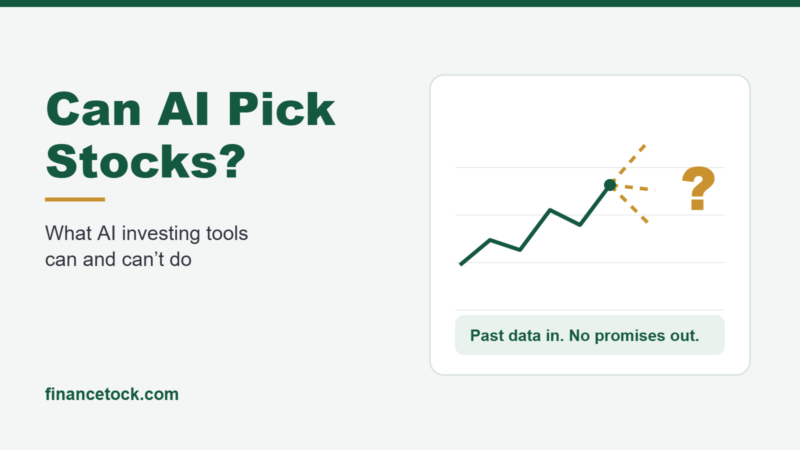
AI models learn from past data. But markets are driven by future events: interest rate decisions, elections, wars, pandemics, new technologies and shifts in investor mood. Patterns that worked in the past often stop working, especially once many people start trading on them.
Beat a market full of other AIs
Professional investors have access to the same technology, faster data and far more resources. Any obvious edge an AI finds tends to disappear quickly as others exploit it.
Know your circumstances
A chatbot doesn’t know your income, debts, goals, tax position or how you’d feel if your investments fell 30%. Suitable investing depends on all of these.
Always get the facts right
General AI assistants can state outdated prices, invent figures or confuse companies, all with complete confidence. Many aren’t connected to live market data, and those that are can still misread it.
Why “Can AI pick stocks?” is the wrong question
In my view, “Can AI pick stocks?” is one of the least important questions most investors can ask.
That’s not because stock selection never matters. It’s because many people focus on finding the perfect investment before they’ve dealt with the factors that historically have had a much bigger impact on long-term results.
What I’ve noticed is that investors are often tempted by the idea that one clever insight, one winning stock or one powerful AI tool will dramatically change their outcome.
Meanwhile, the things they can actually control get less attention:
- How much they’re saving
- What they’re paying in fees
- Whether they’re diversified
- How consistently they invest
- Whether they stay invested when markets become uncomfortable
Those factors aren’t particularly exciting. They also happen to be the areas where many successful long-term investors spend most of their time.
That’s why I think “Can AI pick stocks?” misses the point.
A more useful question might be:
Can AI help me become a better investor?
That’s a much easier argument to make.
AI can help explain concepts, compare costs, summarise research, organise information and help investors think more clearly about decisions. All of those things can be valuable.
But none of them remove the need for patience, diversification, sensible costs and a long-term mindset.
Red flags: AI trading bots and guaranteed returns
AI has become the favourite buzzword of investment scams. US regulators have warned that AI won’t turn trading bots into money machines, and the SEC has fined investment firms for “AI washing”: making misleading claims about their use of AI. Watch for:
- Guaranteed or unusually high returns, such as “2% a day” or “never lose”.
- Vague technology claims: “quantum AI”, “proprietary neural networks” or secret algorithms with no clear explanation.
- Unregulated firms. Check the FCA register in the UK, or FINRA BrokerCheck and the SEC in the US, before handing over any money.
- Celebrity endorsements in adverts or videos, which are often deepfakes.
- Pressure to deposit more or pay “fees” or “taxes” before you can withdraw.
- Requests for payment in crypto or transfers to personal accounts.
Learn how these schemes work in our guide to AI scams targeting your money.
How investors use AI sensibly
Many experienced investors use AI as a tool, not as a decision-maker. Common approaches include:
- Learning: asking AI to explain investing terms, account types and how funds work, then checking the explanation against official sources.
- Research support: summarising a fund’s factsheet or a company’s annual report as a starting point, not a conclusion.
- Checking costs: modelling how platform and fund fees affect long-term returns. Our comparison of investing apps for beginners shows why costs matter.
- Staying disciplined: using AI to draft an investing plan or a checklist that helps avoid emotional decisions.
- Keeping data private: never sharing account numbers, passwords or full personal details with an AI tool.
For many long-term investors, the core of their approach involves no stock picking at all: low-cost, diversified index funds held for many years. Our guides to how to start investing and index funds vs ETFs explain how that works.
Sources and further reading
- S&P Dow Jones Indices: SPIVA research
- SEC: charges against investment advisers for “AI washing” (2024)
- FCA ScamSmart
- Investor.gov (SEC investor education)
- FCA Financial Services Register
Last checked: November 2026.
Frequently asked questions
Can AI predict the stock market?
Not reliably. AI can find patterns in past data, but markets are driven by unpredictable future events, and any edge tends to disappear as other investors use similar tools. No AI can guarantee future returns.
Is it safe to follow stock tips from ChatGPT?
General AI assistants aren’t designed to give investment advice. They may use outdated information, make factual errors and don’t know your circumstances. Many investors use them to learn and research, and check everything against official sources before making decisions.
Are AI trading bots legit?
Some legitimate platforms offer automated trading tools, but many products marketed as “AI trading bots” are scams, especially those promising guaranteed or very high returns. Regulators in the UK and US have warned investors about them.
Do robo-advisors use AI to pick stocks?
Most robo-advisors use algorithms to build and rebalance portfolios of broad index funds based on your goals and risk level. They typically don’t try to pick individual winning stocks.
Should I invest in AI companies or AI funds?
That’s a personal decision that depends on your goals and risk tolerance. Funds focused on a single theme, including AI, are less diversified than broad market funds and can be more volatile. Many broad index funds already include large AI-related companies.
The bottom line
AI is changing investing, but mostly by making research faster and products cheaper, not by turning anyone into a market-beating stock picker. The tools are genuinely useful for learning, summarising and organising information. They’re far less reliable at predicting which shares will rise.
Be very wary of anything that promises AI-powered profits, check that any firm is regulated, and remember that the things investors can control, such as costs, diversification and patience, tend to matter far more over time than any prediction.
This article is for general education only and isn’t personal financial advice. It doesn’t recommend any investment, stock or service. Investments can fall as well as rise, and you may get back less than you invest. Read our disclaimer.