







Last updated:
Most money advice answers one question at a time. Should I save or pay off debt? Is it time to invest? Do I need an ISA? The trouble is that the right answer usually depends on what you’ve already done, and most guides never tell you the order.
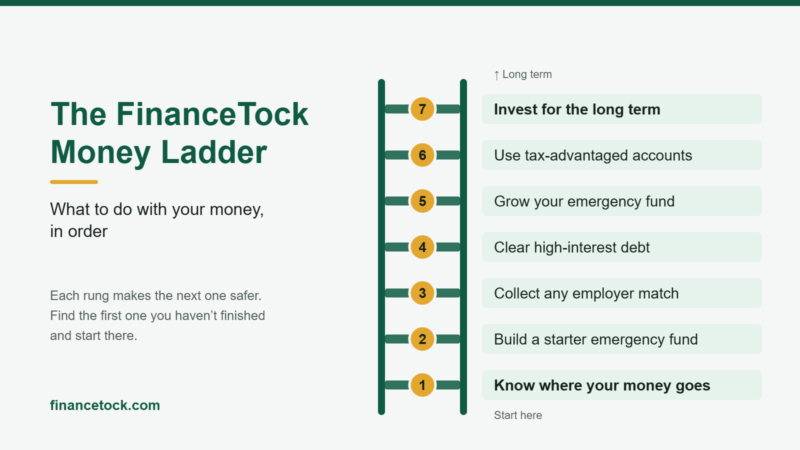
The FinanceTock Money Ladder puts the most common steps in sequence, from your first budget to long-term investing. Each rung makes the next one safer, so climbing in order matters more than climbing fast. It’s not a set of instructions for everyone; it’s the order many people find works, with links to a full guide for every step.
⚡ The short version
- Know where your money goes with a simple budget.
- Build a starter emergency fund of about one month’s essentials.
- Collect any employer pension or 401(k) match.
- Clear high-interest debt, such as credit cards and overdrafts.
- Grow your emergency fund to three to six months of essentials.
- Use tax-advantaged accounts, such as ISAs, pensions and IRAs.
- Invest for the long term and keep going.
Not sure where you are? Find the first rung you haven’t finished and start there.

In this guide
- Why the order matters
- Rung 1: Know where your money goes
- Rung 2: Build a starter emergency fund
- Rung 3: Collect any employer match
- Rung 4: Clear high-interest debt
- Rung 5: Grow your emergency fund
- Rung 6: Use tax-advantaged accounts
- Rung 7: Invest for the long term
- What runs alongside every rung
- The ladder most people climb in the wrong order
- Frequently asked questions
- The bottom line
Why the order matters
Each rung protects the one above it. An emergency fund stops a broken boiler becoming credit card debt. Clearing expensive debt means investment growth isn’t quietly cancelled out by interest. A full safety net means you’re never forced to sell investments at a bad moment to cover a bill.
Skip a rung and the ones above it get wobbly. That’s why someone investing while carrying a credit card balance at a high interest rate often isn’t as far ahead as they think.
| Rung | What it does | Full guide |
|---|---|---|
| 1. Budget | Shows where your money goes | How to budget |
| 2. Starter emergency fund | Stops small surprises becoming debt | How to build an emergency fund |
| 3. Employer match | Collects pay you’d otherwise leave behind | MoneyHelper: Automatic enrolment |
| 4. High-interest debt | Stops interest working against you | Avalanche vs snowball |
| 5. Full emergency fund | Protects you from big shocks, like losing your job | High-yield savings accounts |
| 6. Tax-advantaged accounts | Keeps more of your growth | Choosing the right account |
| 7. Long-term investing | Gives your money time to grow | Index funds vs ETFs |
Rung 1: Know where your money goes
Every other rung needs one number: how much is left after your essentials each month. You can’t build a safety net or clear a debt without knowing what you can put towards it.
- Work out your take-home pay, not your headline salary.
- Look at two or three months of statements and group your spending.
- Pick a simple method, such as 50/30/20 or pay yourself first.
You don’t need special software. A bank app, a spreadsheet or a notebook all work. Our guides to how to budget and the best budgeting apps for beginners cover the options.
You’ve finished this rung when you know your monthly surplus, even if it’s small.
Rung 2: Build a starter emergency fund
A starter fund of about one month’s essential expenses covers most everyday surprises: a car repair, a vet bill, an urgent train fare. It isn’t the full safety net yet; it’s enough to stop a small problem landing on a credit card.
- Keep it separate from your everyday account, so it doesn’t get spent by accident.
- Keep it easy to reach, within a day or two.
- Keep it protected: in the UK, check the provider is covered by the FSCS; in the US, look for FDIC or NCUA cover.
See how to build an emergency fund on a tight budget for 12 ways to get there, and high-yield savings accounts explained for where to keep it.
You’ve finished this rung when you have about one month of essentials set aside.
Rung 3: Collect any employer match
If your employer adds money to a pension or retirement plan when you contribute, that contribution is effectively part of your pay. Not collecting it means leaving pay on the table.
- UK: most employees are automatically enrolled in a workplace pension. For 2026/27 the minimum total contribution is 8% of qualifying earnings, of which at least 3% comes from the employer. Some employers add more if you pay in more, so check your scheme’s rules.
- US: many employers match 401(k) contributions up to a set percentage of salary. Your HR or benefits team can tell you how much you need to contribute to get the full match.
🔄 FinanceTock Contrarian
Many step-by-step money plans say to clear every debt before you put anything towards retirement. We put the employer match first.
Not because debt doesn’t matter. Because a match is part of your pay: if your employer only adds money when you contribute, not contributing means turning that pay down. Even expensive credit card interest is usually smaller than what you’d give up.
So many people do both at once: contribute enough to get the match, and clear debt with the rest of their surplus.
You’ve finished this rung when you’re contributing at least enough to get any match available.
Rung 4: Clear high-interest debt
Credit cards, overdrafts, store cards and payday loans often charge far more interest than savings or investments can reasonably be expected to earn. Every pound or dollar of that debt you clear gives you a return equal to its interest rate, with no risk.
There are two common ways to tackle several debts:
- Avalanche: pay the minimums on everything, then put extra money towards the highest interest rate. This usually saves the most money.
- Snowball: pay the minimums on everything, then attack the smallest balance first. Quick wins keep many people motivated.
Both work. The best one is the one you’ll stick with. Our budgeting guide explains each in more detail.
If debt feels unmanageable, free, confidential help is available. In the UK, MoneyHelper can point you to free debt advice. In the US, the National Foundation for Credit Counseling lists non-profit counsellors. Be wary of any company that charges upfront to make your debts disappear.
One thing to avoid: emptying your starter emergency fund to clear a card faster. It feels efficient, until the next surprise bill goes straight back on the card. Keep the starter fund, and clear the debt from your monthly surplus.
You’ve finished this rung when your expensive debts are cleared. Low-interest debt, such as many mortgages or student loans, can usually wait.
Rung 5: Grow your emergency fund
With expensive debt gone, the money that was going to repayments can build your full safety net. A common target is three to six months of essential expenses, enough to cover bigger shocks such as losing your job.
Many people aim higher if they:
- Are self-employed, freelance or paid mostly by commission
- Rely on a single household income
- Have children or other dependants
This is also a good time to start sinking funds: separate pots for costs you know are coming, such as car insurance, birthdays and holidays. They stop predictable bills from raiding your emergency fund.
You’ve finished this rung when you have three to six months of essentials set aside, or more if your income is irregular.
Rung 6: Use tax-advantaged accounts
Once your safety net is in place, the question becomes where to put money for the long term. Accounts with tax advantages let you keep more of what your money earns.
- UK: a Stocks and Shares ISA lets growth and withdrawals stay free of UK tax, up to an annual allowance of £20,000 across all your ISAs. Pensions, including workplace pensions and SIPPs, add tax relief on what you pay in, but you usually can’t access the money until later in life.
- US: beyond the employer match, many people use an IRA (Traditional or Roth) and contribute more to their 401(k).
Which account comes first depends on your goals and when you’ll need the money. Allowances and rules change, so check the current figures with GOV.UK or the IRS. Our guide to choosing the right type of account explains the main options.
You’ve finished this rung when you know which accounts you’ll use and you’ve opened them.
Rung 7: Invest for the long term
This is the rung most people want to jump to first. By the time you get here, you can invest with money you won’t need for at least five years, knowing a market fall won’t force you to sell.
- Many beginners start with a low-cost, broadly diversified fund, rather than trying to pick individual companies. See index funds vs ETFs.
- Invest regularly, by automatic transfer, rather than waiting for the right moment. See how to start investing with £100.
- Watch the ongoing costs, which matter more over time than any headline offer. See investing apps for beginners compared.
- Learn the warning signs of investment scams, especially anything promising guaranteed returns. See AI scams targeting your money.
From here, the ladder isn’t about climbing higher. It’s about staying on it: investing consistently, keeping costs low and leaving it alone through the ups and downs.
💡 FinanceTock Take
The ladder isn’t a race. Someone on rung two who stays there for a year is often in a stronger position than someone who jumped to rung seven and fell off at the first market dip.
Each rung only has to be finished once. Staying on the ladder is the part that compounds.
What runs alongside every rung
Three things help at every step, wherever you are on the ladder:
- Automate it. Move money to savings, debt or investments on payday, before you can spend it. Automation removes willpower from the equation.
- Check in regularly. A 15-minute money check on the same day each week does more than any app.
- Grow the top line. Every rung gets easier with a bigger surplus. Our guides to freelancing for beginners and realistic ways to make money online cover the options, and side income is usually taxable, so set some aside from day one.
The ladder most people climb in the wrong order
The most common pattern isn’t people doing nothing. It’s people doing the exciting rungs first.
Investing feels like progress. Budgeting and emergency funds feel like admin. So many beginners open an investing app before they know their monthly surplus, put money into the market while carrying a credit card balance, and then have to sell at a loss when the car breaks down.
None of those decisions is unreasonable on its own. The problem is the order. Investing isn’t the wrong move; it’s the right move made too early.
The rungs at the bottom are less exciting, but they’re the ones that make the rungs at the top work. That’s also why the most useful question isn’t “what should I invest in?” It’s “which rung am I actually on?”
🤔 Worth Thinking About
If an unexpected £500 bill arrived tomorrow, where would the money come from?
If the honest answer is a credit card or an overdraft, the most valuable rung for you right now is probably rung two, whatever else you’re doing.
Sources and further reading
- MoneyHelper: Automatic enrolment into a workplace pension
- LITRG: Pensions auto-enrolment contributions
- MoneyHelper: Debt advice locator
- GOV.UK: Individual Savings Accounts (ISAs)
- Financial Services Compensation Scheme (FSCS)
- IRS: Retirement plans
- Consumer Financial Protection Bureau (US)
- National Foundation for Credit Counseling (US)
Last checked: November 2026.
Frequently asked questions
Should I save or pay off debt first?
Many people build a small starter emergency fund first, then focus on high-interest debt, then grow their savings further. Without a starter fund, the next surprise bill often goes straight back on a credit card.
Should I invest while I still have debt?
It depends on the interest rate. High-interest debt, such as credit cards, usually costs more than investments can reasonably be expected to earn, so many people clear it first. Low-interest debt, such as many mortgages, is often paid off alongside investing. Collecting an employer match usually makes sense either way.
How long does it take to climb the ladder?
It varies enormously with income, costs and debt. Some people finish the first few rungs in months; for others it takes years. Progress matters more than speed, and every rung you finish makes you more secure.
Do I have to finish one rung before starting the next?
Not always. Many people collect an employer match while clearing debt, or start a sinking fund while building their emergency fund. The ladder is a guide to priorities, not a strict set of rules.
Is this the same as the “baby steps” I’ve seen elsewhere?
Several personal finance writers suggest an order of steps, and most share the same core idea: protect yourself first, clear expensive debt, then invest. The FinanceTock Money Ladder covers both UK and US accounts and keeps the employer match earlier, because leaving it uncollected means leaving pay behind.
The bottom line
You don’t need to know everything about money to make progress. You need to know which rung you’re on and what the next one is.
Start with a budget, build a small safety net, collect any match, clear expensive debt, grow your safety net, use tax-advantaged accounts and invest for the long term. Each step makes the next one safer.
If you only do one thing today, find the first rung you haven’t finished and open the guide for it. That’s where your next bit of progress is waiting.
This article is for general information and education only and isn’t personalised financial advice. The right order for you depends on your circumstances. Investing involves risk, and you may get back less than you put in. Tax rules and allowances change; check official sources or speak to a regulated adviser if you’re unsure. Read our disclaimer.