






Last updated:
Every side hustle guide tells you how to earn the money. Far fewer tell you how much of it is actually yours. The honest version: side income is usually taxable, but for many people the bill is smaller and simpler than they fear, as long as they plan for it from the first payment.
This guide explains how tax on side income works in the UK and the US: what counts, what’s tax-free, the deadlines that matter, and how much to set aside. It also covers a big change coming in the UK from April 2027.
⚡ The short version
- UK: the first £1,000 of trading income a year is tax-free under the trading allowance. From 6 April 2027, that’s due to rise to £3,000.
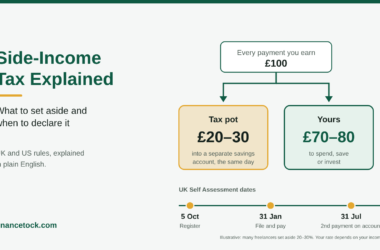
- UK: earn more than the allowance and you’ll need to register for Self Assessment by 5 October after the tax year ends, then file and pay by 31 January.
- US: all side income is reportable. If your net self-employment earnings are $400 or more, you’ll also owe self-employment tax of 15.3%.
- Both: move a share of every payment into a separate savings account the day it arrives, so the tax bill is never a shock.

In this guide
- Side hustle or just a clear-out?
- UK: the trading allowance (and the 2027 change)
- UK: what you’ll actually pay
- UK: registering, filing and paying
- UK: Making Tax Digital
- US: how side income is taxed
- How much to set aside
- Keeping records without the stress
- The mistakes that turn a side hustle into a tax problem
- Frequently asked questions
- The bottom line
Side hustle or just a clear-out?
The first question isn’t how much you earned. It’s what kind of income it is.
- Selling things you no longer want, such as old clothes, furniture or a games console, usually isn’t taxable in the UK, because you’re not trading.
- Buying or making things to sell for a profit is likely to count as trading, and the profit can be taxable.
- Selling your time or skills, such as freelance writing, design, tutoring, dog walking or content creation, is trading income.
Online platforms now report sellers to tax authorities. In the UK, platforms such as marketplaces and gig apps have reported sellers’ details to HMRC since January 2024, unless you make fewer than 30 sales of goods a year and receive less than about £1,700 (€2,000) for them. In the US, payment apps and marketplaces send a Form 1099-K when payments for goods or services go over $20,000 in more than 200 transactions.
A report doesn’t automatically mean you owe tax, and no report doesn’t mean you don’t. What matters is whether you’re trading.
UK: the trading allowance (and the 2027 change)
The trading allowance lets you earn up to £1,000 a year in gross trading income tax-free. It covers all your side hustles and self-employed work added together, not £1,000 each. The UK tax year runs from 6 April to 5 April.
- £1,000 or less in gross trading income: you usually don’t need to tell HMRC, though you should still keep records.
- More than £1,000: you need to register for Self Assessment. You can then either deduct the £1,000 allowance or your actual business expenses, but not both.
The allowance can’t be used for income from a company or partnership you’re connected to, or for work you do for your own employer (or your spouse’s or civil partner’s employer).
The change coming in April 2027
In the Autumn Budget on 28 October 2026, the government announced that the trading allowance will rise from £1,000 to £3,000 from 6 April 2027, with the reporting threshold rising to match. The change still has to pass into law through the Finance Bill.
Until then, the £1,000 limit still applies. If your trading income goes over £1,000 in the 2025/26 or 2026/27 tax year, you still need to register and file a return for that year.
Allowance or expenses: a worked example
Here’s an illustrative example for a basic-rate taxpayer in England with a side hustle that brings in £4,000 a year and has £600 of expenses:
| Option | Taxable profit | Income tax at 20% |
|---|---|---|
| Claim the £1,000 trading allowance | £3,000 | £600 |
| Claim actual expenses (£600) | £3,400 | £680 |
| Claim the £3,000 allowance (from 2027/28, if passed) | £1,000 | £200 |
The rule of thumb: if your expenses are lower than the allowance, claiming the allowance usually means less tax. If your expenses are higher, or you’ve made a loss you want to use, claiming expenses usually works out better. The figures are illustrative; your own bill depends on your other income, and Scotland has different income tax bands.
UK: what you’ll actually pay
Side-hustle profit is added to your other income, such as your salary, and taxed at your normal income tax rate. The first £12,570 of your total income is usually covered by your Personal Allowance, which a salary often uses up already.
Self-employed people also pay National Insurance on their profits, but the thresholds apply to your self-employed profits on their own, not combined with your salary:
- Class 4 National Insurance (2026/27): 6% on profits between £12,570 and £50,270, and 2% above that.
- Class 2 National Insurance: if your profits are £7,105 or more, it’s treated as paid, so you don’t pay anything. Below that, you can choose to pay voluntary contributions (£3.65 a week) to protect your State Pension record.
🎯 Reality Check
Many people assume a side hustle means paying income tax and a big National Insurance bill. For a small side hustle, it usually doesn’t.
Class 4 National Insurance only starts once your self-employed profit, on its own, goes over £12,570. Someone with a full-time salary and a few thousand pounds of side profit will often owe income tax on that profit and no National Insurance at all.
UK: registering, filing and paying
Self Assessment runs on a fixed calendar. For income earned in the tax year that ends on 5 April:
| What | Deadline |
|---|---|
| Register for Self Assessment (first year only) | 5 October after the tax year ends |
| File a paper return | 31 October after the tax year ends |
| File online | 31 January after the tax year ends |
| Pay the tax you owe | 31 January after the tax year ends |
| Second payment on account (if you have to make them) | 31 July |
So for the 2025/26 tax year, which ended on 5 April 2026, the online return and payment are both due by 31 January 2027. Filing late usually means an automatic £100 penalty, even if you don’t owe any tax.
Payments on account: the surprise many people don’t see coming
If your Self Assessment bill is more than £1,000, HMRC usually asks you to pay towards next year’s bill in advance, in two instalments called payments on account. Each one is normally half of the previous year’s bill.
That means your first January bill can be much bigger than you expect: the full tax for last year, plus the first payment on account for this year. You can ask HMRC to reduce your payments on account if you expect to earn less.
UK: Making Tax Digital
Making Tax Digital for Income Tax requires sole traders and landlords above certain income levels to keep digital records and send HMRC regular updates using compatible software. It’s being phased in by qualifying income (from self-employment and property):
- Over £50,000: from 6 April 2026
- Over £30,000: from 6 April 2027
- Over £20,000: from 6 April 2028
Most people with a small side hustle won’t be affected yet, but it’s worth keeping digital records from the start so a future switch is easy. Use HMRC’s Making Tax Digital checker to see when it applies to you.
US: how side income is taxed
In the US, there’s no equivalent of the UK trading allowance. All side income must be reported on your tax return, whether or not you receive a tax form for it.
Self-employment tax
If your net earnings from self-employment are $400 or more in a year, you’ll owe self-employment tax on top of income tax. It covers Social Security and Medicare, the same taxes an employer would normally split with you.
- Rate: 15.3%, made up of 12.4% for Social Security and 2.9% for Medicare.
- What it’s charged on: 92.35% of your net self-employment earnings.
- Social Security cap: the 12.4% part applies only up to a combined wage base of $184,500 in 2026, which includes any salary you earn.
- A deduction: you can deduct the employer-equivalent portion of self-employment tax when working out your adjusted gross income, which reduces your income tax.
For example, $5,000 of net side-hustle earnings would mean roughly $706 in self-employment tax ($5,000 × 92.35% × 15.3%), before income tax. Illustrative only; state taxes and your other income change the total.
Estimated tax payments
Employers withhold tax from salaries, but nobody withholds it from side income. If you expect to owe $1,000 or more when you file, the IRS generally expects you to pay estimated tax during the year, usually in four instalments (mid-April, mid-June, mid-September and mid-January). Paying too little can mean a penalty. Many people with a salary avoid estimated payments by asking their employer to withhold a little more tax instead.
Tax forms you might receive
- Form 1099-NEC: from clients who paid you for services. For payments made in 2026, the reporting threshold rises from $600 to $2,000.
- Form 1099-K: from payment apps and online marketplaces, if payments go over $20,000 in more than 200 transactions.
Not getting a form doesn’t mean the income isn’t taxable. Keep your own records either way.
How much to set aside
A common approach is to move a fixed share of every payment into a separate savings account the day it arrives. Many freelancers use somewhere between 20% and 30%. Here’s how to think about the right figure for you:
- UK basic-rate taxpayer with a small side hustle: income tax at 20% on profit above the allowance, often with no National Insurance, so 20% of profit is usually enough.
- UK higher-rate taxpayer: income tax at 40% on profit, so set aside more.
- Self-employed full-time (UK): add Class 4 National Insurance once profits pass £12,570, and remember payments on account.
- US: add 15.3% self-employment tax to your income tax rate, plus any state tax. That’s why many US freelancers set aside 25% to 30% or more.
Keep the tax pot in an easy-access savings account so it earns some interest while it waits. Our guide to high-yield savings accounts explains the options. Over-saving is a nice problem: whatever’s left after the bill is yours.
🔄 FinanceTock Contrarian
Most beginners spend more time choosing a side hustle than thinking about where the tax will come from.
That’s backwards.
The easiest side-hustle tax bill you’ll ever pay is the one you started saving for on the day you earned the money.
A complicated tax return with money set aside is usually manageable. A simple tax return with nothing set aside is where the stress starts.
Keeping records without the stress
Good records make your return quicker and your expenses easier to claim. You don’t need special software to start:
- Use a separate bank account for side-hustle money, even a free one. It turns record-keeping into reading one statement.
- Log every payment and expense in a simple spreadsheet: date, what it was, amount.
- Keep receipts, ideally as photos or PDFs in one folder.
- Keep records for long enough: in the UK, at least five years after the 31 January deadline for that year’s return. In the US, the IRS generally recommends at least three years, and longer in some situations.
If you’d like help building a simple tracker, our ChatGPT money prompts include ones for spreadsheets and irregular income. Never paste account numbers or other sensitive details into an AI tool.
The mistakes that turn a side hustle into a tax problem
Most side-hustle tax problems don’t come from complicated rules. They come from a few ordinary habits.
1. Spending the gross
The money that lands in your account feels like yours. Part of it isn’t. People who treat every payment as spending money are the ones who meet January with nothing set aside.
2. Missing the registration deadline
The filing deadline gets all the attention, but the first deadline for a new side hustle in the UK is 5 October, to register. Missing it can lead to penalties if you then pay late.
3. Forgetting about payments on account
Someone whose side hustle grows quickly can face a January bill covering last year’s tax plus half of this year’s in advance. It’s the single biggest shock for new sole traders.
4. Assuming no form means no tax
Platforms only report above certain thresholds. The rules on what’s taxable are separate from the rules on what gets reported.
5. Mixing personal and business money
It makes records harder, expenses easier to miss and mistakes more likely. A separate account fixes most of it in one step.
🤔 Worth Thinking About
If your side hustle earned an extra £3,000 next year, how much of it would you need to set aside, and where would that money sit until January?
If you can’t answer quickly, set up the separate account and the standing transfer before the next payment arrives, not after.
Sources and further reading
- GOV.UK: Tax-free allowances on property and trading income
- HMRC Tax Confident: Tax on extra income and side hustles
- GOV.UK: Register for Self Assessment
- GOV.UK: Self Assessment deadlines
- GOV.UK: Payments on account
- GOV.UK: Self-employed National Insurance rates
- GOV.UK: Making Tax Digital for Income Tax
- GOV.UK: Selling goods or services on a digital platform
- Alliotts: Trading allowance to increase to £3,000 from April 2027
- IRS: Self-employment tax
- IRS: Estimated taxes
- IRS: Understanding your Form 1099-K
Last checked: November 2026.
Frequently asked questions
How much can I earn from a side hustle before paying tax in the UK?
Up to £1,000 of gross trading income a year is covered by the trading allowance, so there’s usually no tax and nothing to report. From 6 April 2027, that’s due to rise to £3,000, once the change passes into law.
Do I need to register as self-employed for a side hustle?
In the UK, if your gross trading income is more than £1,000 in a tax year, you need to register for Self Assessment by 5 October after that tax year ends. You can register while still employed; a side hustle and a job can run side by side.
Is money from selling my old things taxable?
Usually not, if you’re selling personal belongings you no longer want. Buying or making things specifically to sell for a profit is different and is likely to count as trading.
Do I pay National Insurance on side-hustle income?
In the UK, Class 4 National Insurance only applies once your self-employed profit, on its own, is over £12,570 a year. Many people with small side hustles pay income tax on their profit but no National Insurance.
Do I have to pay tax if I didn’t get a 1099 form?
Yes. In the US, all income is reportable whether or not you receive a Form 1099-NEC or 1099-K. The forms are about what gets reported, not what’s taxable.
Should I use an accountant?
Many people with a simple side hustle file their own return. An accountant can be worth it if your income is growing quickly, you have several income sources, or you’re unsure what you can claim. For anything beyond the basics, professional advice usually pays for itself.
The bottom line
Side-hustle tax isn’t something to fear, but it is something to plan. Know whether you’re trading, use the allowance if you’re in the UK, register on time, and set money aside from every payment.
The most useful thing you can do today takes five minutes: open a separate savings account for tax and set up a standing transfer for a share of every payment. Everything else is paperwork.
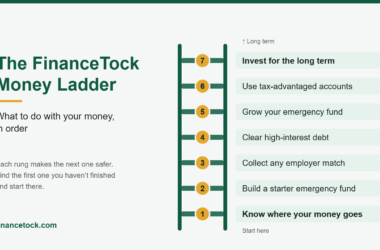
If you’re just getting started, our guides to freelancing for beginners and realistic ways to make money online cover the earning side. To see where side income fits in your wider finances, see the FinanceTock Money Ladder.
This article is for general information only and isn’t tax, legal or financial advice. Tax rules, rates and thresholds change and depend on your circumstances, and the April 2027 trading allowance change still has to pass into law. Check official guidance from HMRC or the IRS, or speak to a qualified accountant. Read our disclaimer.