







Search for “make money online” and you’ll find promises of overnight riches. This guide is different. Below are twelve ways people genuinely earn money on the internet, grouped by how fast they pay and how much effort they need. None of them is passive on day one, and every one of them rewards consistency more than luck.
Quick summary: if you need money soon, start with a skill-based option (freelancing or AI-assisted services). If you can wait six months or more, build an asset (a blog, a YouTube channel or a digital product) that keeps earning after the work is done.
Part 1: Earn from your skills (fastest to first payment)
1. Freelancing
Freelancing is still the most reliable way to start earning online, because clients pay for results you can deliver this week. Writing, design, web development, video editing, bookkeeping and social media management are all in steady demand.
- Where to find work: Upwork, Fiverr and Freelancer, plus LinkedIn and industry job boards.
- Step-by-step guide: freelancing for beginners: how to land your first client.
- How to stand out: a narrow offer (“product descriptions for Shopify stores” beats “writer”), two or three portfolio samples, and fast, clear replies to clients.
- Watch out for: under-pricing yourself for too long. Raise your rate after every few good reviews.
2. AI-assisted services
AI tools have created a new category of freelance work: helping businesses actually use them. Small businesses pay for people who can set up chatbots, automate repetitive tasks, write prompt libraries, or produce content faster with AI and then edit it to a professional standard.
The opportunity isn’t in pressing a button; it’s in combining AI speed with human judgment. Learn one or two tools deeply, document a before-and-after result, and sell that outcome.
3. Online tutoring and coaching
If you’re strong in a school subject, a language, a musical instrument or a professional skill, platforms such as Preply, Tutor.com and Wyzant connect you with students. Once you have reviews, you can move clients to your own booking page and keep more of the fee.
4. Virtual assistance
Busy founders and creators need help with email, scheduling, research and customer support. It’s a good entry point if you’re organised but don’t yet have a specialist skill, and it often leads to higher-paid operations or project-management roles.
Part 2: Sell products (more setup, more upside)
5. Digital products
Templates, spreadsheets, planners, ebooks, prompt packs and design assets are made once and sold many times. There’s no inventory or shipping, which makes them one of the best-margin businesses online.
Start small: solve one specific problem (a monthly budget spreadsheet, a content calendar template) and sell it for a modest price. Customer questions will tell you what to build next.
6. Online courses
A course is a bigger digital product built around a transformation: “go from X to Y.” Platforms like Udemy give you an audience but control the pricing; tools like Teachable or a WooCommerce store on your own site let you set prices and keep the customer relationship. Validate demand first, for example by running a live workshop, before recording hours of video.
7. E-commerce and dropshipping
With Shopify or WooCommerce you can open an online store without writing code. Dropshipping lets you sell without holding stock: the supplier ships directly to your customer. It’s easy to start but competitive, so success depends on choosing a niche, testing products cheaply and getting good at marketing. Expect thin margins until you find a winning product.
8. Print-on-demand and handmade goods
Designers can sell artwork on t-shirts, mugs and posters through print-on-demand services, which handle printing and shipping. Crafters can sell handmade items on Etsy. Both reward a distinctive style and good product photos.
Part 3: Build an audience (slowest start, longest-lasting income)
9. Blogging
A blog that answers real questions in a clear niche can earn from display ads, affiliate links, sponsorships and your own products, often all at once. Our guide to starting a blog that makes money covers each step, with honest timelines and costs. It typically takes six to twelve months of regular publishing before search traffic becomes meaningful, so pick a topic you’re happy to write about for years.
You’ll need reliable hosting and a domain to start; see our guide to choosing web hosting.
10. Affiliate marketing
Affiliates earn a commission when someone buys through their link. It works best when you genuinely use and recommend a product, and when your content helps people decide, such as reviews, comparisons and tutorials. Software and AI tools are attractive because many programmes pay recurring commissions. Always disclose affiliate links; it’s both a legal requirement in many countries and essential for trust. Our beginner’s guide to affiliate marketing covers programmes, content that converts and the disclosure rules.
11. YouTube, streaming and social content
Video creators earn from platform ad revenue, memberships, sponsorships and affiliate links. Gamers can stream on Twitch or YouTube; educators can teach on YouTube or TikTok. Growth is unpredictable, so treat it as a long-term project and repurpose each video into short clips and blog posts.
Part 4: Small extras (useful, but not a business)
12. Surveys, microtasks and user testing
Sites such as Swagbucks, Survey Junkie, Prolific and Amazon Mechanical Turk pay small amounts for surveys and simple tasks, and user-testing platforms pay a little more for recorded feedback on websites and apps. These are fine for filling idle minutes, but they won’t replace an income. Only use well-known platforms, and never pay to join one.
How to choose the right option for you
Here’s how the main options compare at a glance:
| Method | Time to first income | Difficulty | Long-term potential |
|---|---|---|---|
| Freelancing | Fast | Medium | Medium |
| AI-assisted services | Fast | Medium | High |
| Tutoring and coaching | Fast | Medium | Medium |
| Digital products | Slow | Medium | High |
| Blogging | Slow | High | High |
| Affiliate marketing | Slow | High | High |
| YouTube and social content | Slow | High | High |
| Surveys and microtasks | Fast | Low | Low |
These are rough guides: your existing skills and the time you can give will shift them. With that in mind:
- Need income within a month? Freelancing, AI-assisted services, tutoring or virtual assistance.
- Have some savings and can wait? Blogging, YouTube or affiliate content, ideally paired with a digital product.
- Like making things? Digital products, print-on-demand or handmade goods.
- Have deep expertise? Coaching and online courses.
Tax on side income
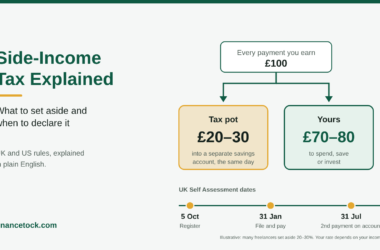
- FinanceTock: Side-income tax explained (UK and US)
- GOV.UK: The £1,000 trading allowance (UK)
- IRS: Gig economy tax center (US)
Last updated: November 2026.
How to avoid scams
Be wary of anything that asks you to pay upfront to “unlock” earnings, promises guaranteed returns, or pressures you to recruit friends. Legitimate work pays you; it doesn’t charge you to start. If an offer sounds too good to be true, it almost always is.
The bottom line
There aren’t a million ways to make money online, but there are a dozen good ones. Pick one that fits your skills and timeline, commit to it for at least three months, and add a second income stream only once the first is working. Small, steady progress beats chasing every new trend.
Most people don’t fail because they picked the wrong way to make money online. They fail because they switch to a different one before the first had time to work.
This article is for general information only and isn’t financial advice. Earnings vary widely and depend on your skills, effort and circumstances.